
Journal
How to Create a Low-Stimulation Home for Toddlers and Mothers
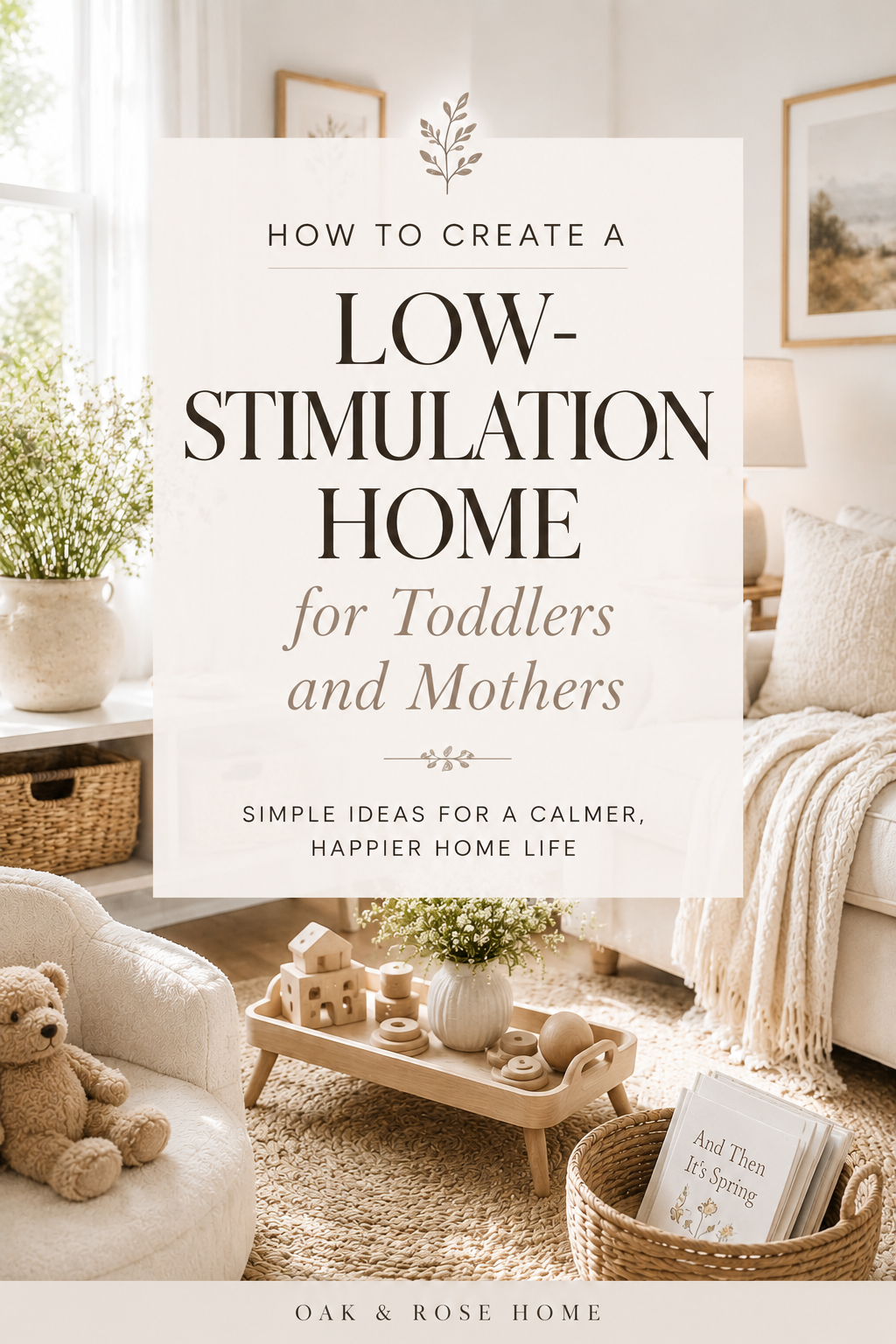
There is a particular kind of tiredness that comes from living in a home that never goes quiet. The lights are always on. The toys hum and beep. A screen plays in the background. The toddler is overwhelmed, the mother is overstimulated, and by lunchtime no one is quite sure why everyone feels so frayed.
A low-stimulation home is not minimalism. It is not an aesthetic for its own sake. It is a quiet, deliberate choice to let the home rest — visually, sonically, emotionally — so that the small people inside it can rest too. And so that mothers, who often carry the weight of the room’s energy without realizing it, can stop bracing.
This is a gentle field guide to creating a low-stimulation home for toddlers and mothers — beginner-friendly, built on small shifts rather than big overhauls, and rooted in the slow, intentional homemaking we love most.
What a low-stimulation home actually means
Low stimulation does not mean empty, sterile, or cold. It means a home that asks less of the nervous system at any given moment.
For a toddler, this is the difference between a play corner with three carefully chosen wooden toys and a basket overflowing with thirty plastic ones that flash, sing, and demand attention. For a mother, it is the difference between a kitchen counter that holds one ceramic vase and a kitchen counter that holds mail, dishes, a forgotten sippy cup, a vitamin bottle, and a small monument to last Tuesday.
The best calm home ideas tend to share a few quiet characteristics: muted colors, fewer visible objects, soft natural light, gentler sounds, and rooms with clear purpose. None of these require buying anything. Most of them ask you to remove rather than add.
Why this matters for mothers, too
Most writing about toddler regulation centers on the child. But mothers live in the same room. A mother whose nervous system is constantly asked to filter overhead lighting, background noise, visual clutter, and her child’s bigger emotions has less capacity left for the gentle, present mothering she wants to do.
Intentional motherhood begins, in part, with the environment. When the room is calmer, the mother is calmer. When the mother is calmer, the toddler borrows from her steadiness. The whole household exhales together. (If you are mid-overwhelm right now, our calm motherhood reset is the longer-form version of this principle.)
This is not about Pinterest perfection or aesthetic performance. It is about giving yourself a room to be a mother in.
Simple shifts toward a calmer home
Begin small. None of this needs to happen at once.
Quiet the visual field
Most toddler home ideas focus on what to add — a sensory bin, a reading corner, a play kitchen. Begin instead with what to subtract. Choose a single room and clear every surface to its essentials. Move twenty percent of the toys out of sight, and rotate them weekly. The toddler’s interest stays fresh without growing the inventory.
Lean toward warm neutrals — cream, oat, soft taupe, gentle wood. Children’s nervous systems respond to color and movement; a quieter palette helps the eyes rest.
Lower the lights
Overhead white LED lighting is one of the most overlooked sources of household overstimulation. Switch to warm-white bulbs (2700K is the soft, hearth-like number to look for). Use lamps in the evening instead of overhead lights. Light a candle at dinner. The body reads firelight as safety.
Soften the sound
A low-stimulation home is not a silent home — children need to hear conversation, music, and the ordinary clatter of a kitchen. But constant background audio, especially television or fast-moving children’s content, asks the brain to keep filtering.
Try a single hour each morning with no audio. Open a window instead. Let the toddler hear birds, traffic, your voice. You may notice their play deepens almost immediately.
Curate the toys
Fewer, better toys almost always lead to longer, calmer play. A small basket of open-ended wooden toys, a few books, a doll, and a set of nesting cups will keep a toddler busier than a hundred plastic novelties.
The truth most mothers discover when they finally edit the toy bin is that the toddler did not mind. The toddler often relaxed.
Build rhythm before routine
Peaceful parenting leans heavily on predictability — but rigid routines can feel impossible with a small child. A rhythm is gentler than a schedule: morning slow time, snack, outside, lunch, nap, quiet play, dinner, bath, story, bed. The same shape every day, the clock allowed to be approximate.
Toddlers settle when they can predict what comes next. Mothers settle when the day has a shape they don’t have to invent every morning. If you’d like a starting point, our soft homemaking checklist is a one-page rhythm card built for exactly this.
Make the screen smaller
A toddler home does not need to be screen-free to be calm. But screens — even the well-curated ones — pull the room’s attention sharply. Keep them on a single device, in a single room, for a defined window. Outside that window, let the room belong to the slower things.
A free low-stimulation home checklist
For the days when the shifts above feel hard to remember, we made a small printable summary — soft enough to slip onto a nursery wall, into a kitchen drawer, or onto the refrigerator door.
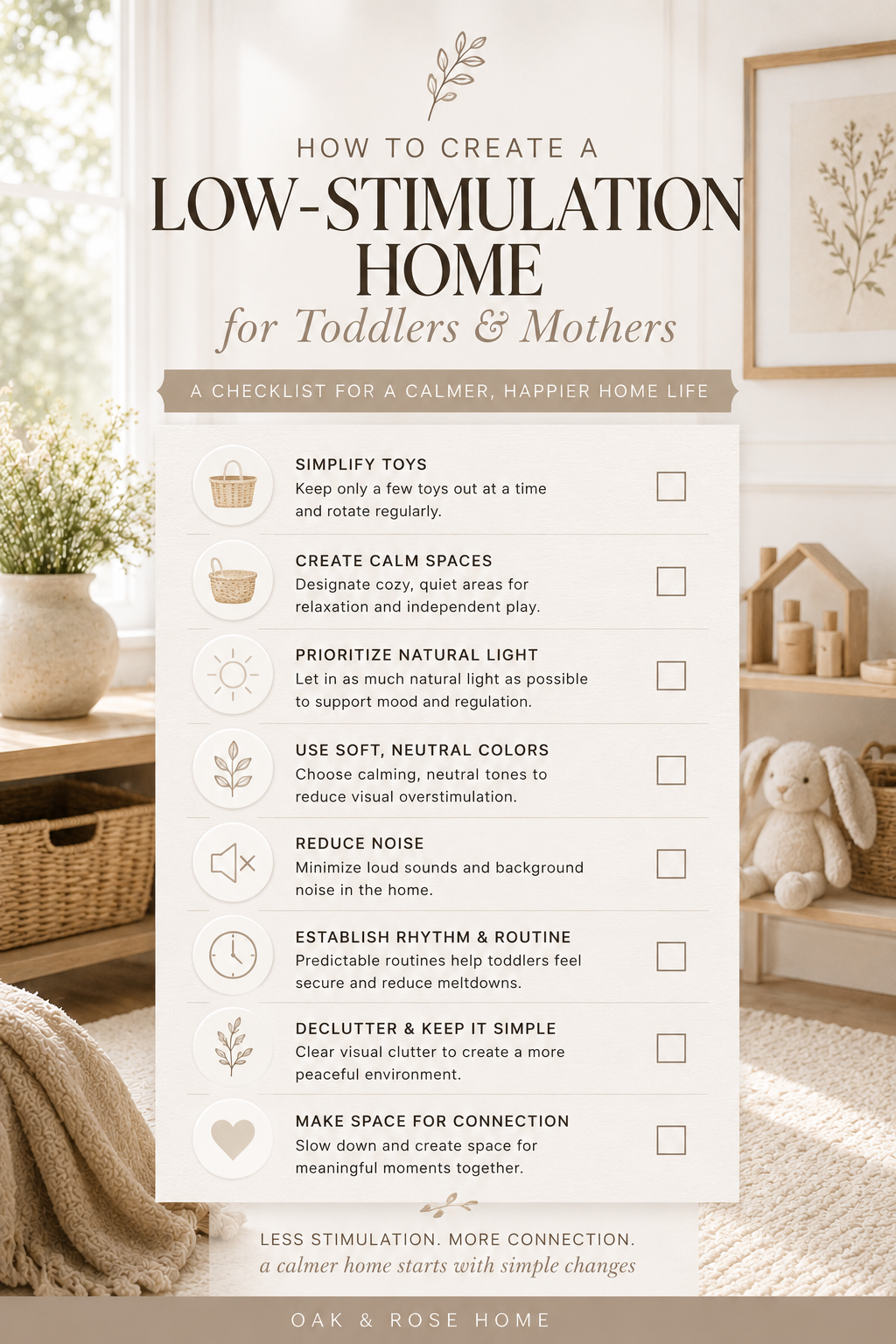
Download the low-stimulation home checklist (PDF)
Peaceful parenting begins in the room
Mothers are often told that calm parenting is something they generate from inside — meditate more, breathe deeper, regulate first. This is true, and it is also incomplete. A nervous system is not separate from the room it lives in. Lower the lights, quiet the toys, soften the audio, and you have done some of the work before the day even begins.
This is what we mean, here at Oak & Rose, by intentional motherhood. Not a curated aesthetic for the internet. A home arranged so that the people in it can be slower, kinder, more themselves.
Start with one surface. Then one corner. Then one room. The house, like the child, will settle.
If you are looking for a small, screen-free toddler activity to begin with, our free toddler farm animal coloring pages are a quiet way to spend a calm afternoon at the kitchen table. And when the day softens toward evening, our soft bedtime routine for toddlers carries the same principle into the hardest hour of the day.
— Oak & Rose Home
Common questions
What does a low-stimulation home actually mean?
A home that asks less of the nervous system at any given moment. Not empty or sterile — just fewer visible objects, softer light, gentler sounds, rooms with clear purpose. For toddlers and mothers especially, nervous systems regulate better in calmer rooms.
How do I lower stimulation for my toddler without depriving them?
The shift is rarely about taking away — it's about rotating. Fewer toys visible at once, longer attention with each. Warmer lighting instead of bright overheads. Quieter background audio. Toddlers often relax visibly when the room itself softens.
What's the difference between low-stimulation and minimalism?
Minimalism is an aesthetic of fewer things. Low-stimulation is a sensory practice — reducing what the nervous system has to filter. A warm, layered, cozy home can be low-stimulation; a sleek empty room can be high-stimulation if it's brightly lit and noisy.
Does this work for older children too?
Yes. The principles scale to elementary-age children and even teens, though the specific applications change (homework area instead of toy basket, music volume instead of TV background). The underlying idea — a home that helps the nervous system regulate — is universal.