
Journal
The Calm Motherhood Reset: From Chaos to Peace at Home
There is a specific kind of exhaustion that doesn’t go away with sleep. It is the bone-deep tiredness of a nervous system that has been on all day — managing meltdowns, sorting laundry, deciding what is for dinner, hearing the small loop of a toy that won’t stop singing in the next room. By the end of the day, you are not just tired. You are overstimulated. And the next morning, before anyone is even awake, you can feel the weight of it already waiting for you.
If that resonates, you are not broken and you are not failing. You are an overstimulated mother in an overstimulating world, and you are far from alone.
The calm motherhood reset is not a productivity hack or a new routine to layer on top of an already-too-full life. It is the opposite — a soft, gentle subtraction. A return to the quiet that lives underneath the noise. And it begins, almost always, at home.
Signs you’re an overstimulated mother
Most mothers know something is wrong before they have a word for it. They simply feel “off” — irritable for no clear reason, short-fused with the people they love most, drained by interactions that used to feel easy. The body keeps the score quietly.
Some of the quieter signs of maternal overstimulation:
- You flinch at small sounds — the sippy cup falling, the toddler calling your name for the hundredth time, the television turned up two notches.
- You feel jumpy when someone touches you, even your own child.
- You crave silence with an almost-physical hunger when the kids finally sleep.
- You scroll your phone after bedtime — not because you want to, but because your nervous system can’t yet do the work of settling.
- The thought of doing anything else — a phone call, a load of laundry, a conversation with your partner — feels like one task too many.
- You feel guilty about all of it.
None of these are character flaws. They are the predictable, biological responses of a mother whose nervous system is being asked to process more than any nervous system was built for. Naming the experience is the first quiet step out of it.
Why the home settles first
When mothers ask how to feel calmer, they usually expect me to recommend a routine, a breathwork practice, or a productivity system. Those things have their place. But almost without exception, the first thing that needs to soften is the home itself.
Your body is not separate from the room it lives in. A nervous system in a cluttered, overhead-lit, sound-saturated home cannot regulate, no matter how many deep breaths it takes. A nervous system in a calmer room, even briefly, will start to settle on its own.
Calm is not just a feeling. It is also a place.
What the calm motherhood reset actually is
A reset, in this brand’s vocabulary, is not a deep clean or a big overhaul. It is a small, repeatable practice that returns a home — and the mother inside it — to its softer baseline. You can do a full reset in a single afternoon and a mini-reset in five quiet minutes between naps.
The reset works on four layers: visual, sound, nervous system, and rhythm. You do not need to do all four at once. Start where you have the smallest amount of resistance.
A visual reset
Pick one room. Clear every surface to its essentials. Move twenty percent of the visible objects out of sight — into a basket, a drawer, anywhere temporary. The toddler’s toys. The mail. The supplements. The cup left from morning. None of it needs to go away forever. It just needs to disappear for now.
Then stand in the doorway and look at the room.
Notice that you can breathe more deeply, just by being in it.
This is not about minimalism or aesthetics. It is about giving your eyes a place to rest. If you’d like more on this gentle philosophy, our quiet introduction to the art of soft homemaking is built on the same foundation: less, more beautifully.
A sound reset
Try a single hour with no audio. No music, no television, no podcast in the background. Open a window if you can. Let the children hear birds, traffic, your voice, the kettle.
Their play tends to deepen almost immediately. So does yours.
Constant background sound is one of the most underestimated sources of maternal exhaustion. The brain works harder than we realize to filter it. For the children especially, a quieter home is a kindness — and the foundation of a more peaceful childhood. We’ve written about this more fully in how to create a low-stimulation home for toddlers and mothers.
A nervous system reset
This is the smallest and most powerful of the four. You can do it in two minutes.
Sit down. Anywhere. Place one hand on your chest and one on your belly. Breathe in slowly through your nose for a count of four. Hold for two. Exhale through your mouth, twice as long as the inhale.
Repeat ten times.
You are not “calming down.” You are signaling to your body that it is safe. The body always listens. It simply needs to be told.
Pair this with one warm thing — tea, a candle, a wool throw, a soft sweater — and the parasympathetic nervous system has everything it needs to begin softening. This is the same gentle work the body wants to do at the end of every day. We just rarely give it the chance.
A rhythm reset
If the days are running together and feel chaotic, write down — or just notice — the shape of yesterday. Most mothers will discover the chaos is not in the what of the day, but in the order. When the morning is allowed to be slow, the rest of the day follows.
Try, for one week, a small morning ritual that belongs only to you. Steep tea. Light a candle. Open a window. Stand in the kitchen with no phone, no task, for three minutes before anyone is awake.
It changes the entire shape of the day.
Soft systems for overwhelmed moms
A “soft system” is not a productivity framework. It is the smallest possible commitment that keeps the household running without asking the mother to be the constant decision-maker.
A few that mothers tell us changed everything:
- The same breakfast every weekday morning. Choose one. Stop deciding.
- One basket per room. When the family arrives home, items go in the basket of the room they belong in — not where they were dropped.
- A single beautiful surface in every room — a windowsill, a counter, a mantel. Keep it lovely. The eye rests there. The mind borrows the rest.
- An evening reset, before bed. Five minutes. Folding throws, returning cups, dimming lamps. Morning meets a calmer house.
- A “nothing is wrong” hour. One block of time each day where no one has to be doing anything productive. Tea, a book, the children playing quietly on the floor.
You do not need all of them. You need one, repeated for two weeks, until it stops feeling like a system and starts feeling like a rhythm.
A free Calm Motherhood Reset Checklist
We made a small printable — soft enough to slip onto a fridge or into a kitchen drawer — that holds these four resets in one page. It is meant to live where you can see it on the hardest days, when remembering anything new feels like one task too many.
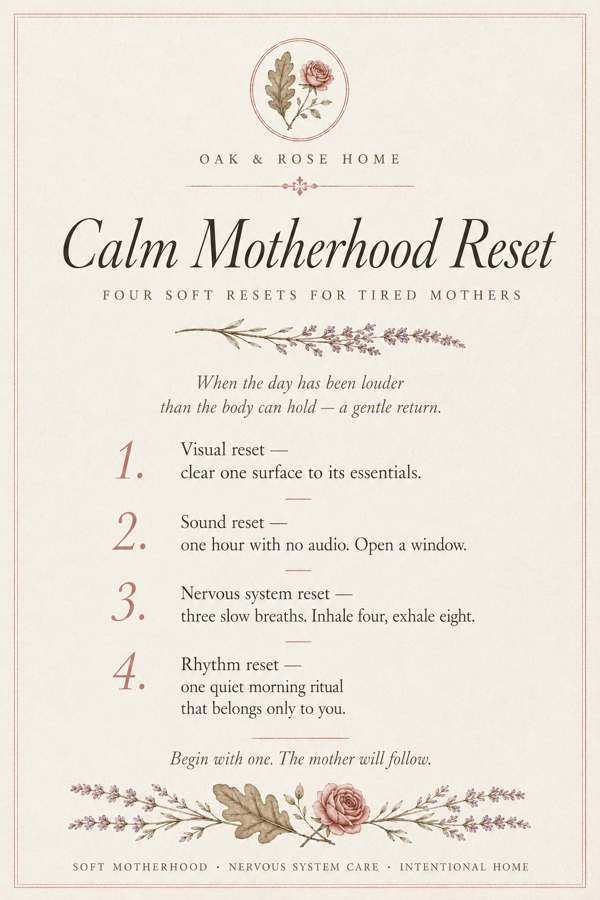
Download the Calm Motherhood Reset Card (PDF)
When you subscribe to the Oak & Rose Home journal below, we’ll send it your way — along with a quiet note when new printables and journal entries arrive. No noise. No selling. Just the small, peaceful things that help.
If the reset is the longer Saturday-afternoon version, the 7-minute morning reset for mothers is its daily, smaller cousin — a soft return at the beginning of each day. And if bedtime is the hour falling apart, our soft bedtime routine for toddlers carries the same idea into the hardest part of the day.
A note before you close this page
If you do nothing else after reading this — no resets, no checklists, no new routine — please do one thing: notice that you are an overstimulated mother in an overstimulating world, and that this is not a personal failure.
You are not behind. You are not the only one. The chaos is not your fault. And the path back to calm is shorter than you think — it begins not with doing more, but with letting the home, and your body, do less.
Begin with one surface. Then one corner. Then one room.
The house, like the child, will settle.
— Oak & Rose Home
Common questions
What are the signs of an overstimulated mother?
Flinching at small sounds, jumpiness around touch, an almost-physical hunger for silence when the kids sleep, scrolling the phone after bedtime without wanting to, feeling guilty about all of it. These are predictable nervous-system responses, not character flaws.
How long does the calm motherhood reset take?
A full reset takes one quiet afternoon. A mini-reset takes five minutes between naps. The full version restores a room and a body to baseline; the mini-reset just gives your nervous system a brief, soft re-anchor.
Why does my home affect my mood so much as a mother?
Your body isn't separate from the room it lives in. A nervous system in a cluttered, brightly-lit, sound-saturated home can't regulate well, no matter how many deep breaths it takes. Softer rooms produce softer mothers; the order is real.
Is the reset just for mothers with young children?
No — the principle scales. A nervous system in an overstimulating room is overstimulated regardless of the children's ages. Mothers of teens and grown kids find the same reset works on the same biological mechanism.