
Journal
A Soft Bedtime Routine for Toddlers (That Actually Works)
There is a particular flavor of evening that every mother of a toddler knows. The kitchen is louder than it was an hour ago. Dinner sticks to the floor. Someone’s voice is just a little too loud. By 6:30 pm, the small person you love most in the world is somehow running across the living room with one shoe on, refusing pajamas, eating a banana someone else handed them. And you are tired. So very tired.
Bedtime is the hardest part of the day for most mothers — not because toddlers are difficult (they are doing what tiny nervous systems do at the end of a long day), but because by the time it arrives, no one is at their best. Not the toddler. Not the mother. Not the home.
A soft bedtime routine doesn’t fix this. What it does is much smaller and much more powerful: it gives the family a shape to fall into, even on the hard nights. Especially on the hard nights.

Why bedtime feels like the hardest hour
A toddler’s nervous system at 6 pm is rarely “tired and ready for sleep.” It is usually overstimulated, dysregulated, hungry, and bracing for a transition. Their body wants to wind down but their brain hasn’t yet learned how. So they reach for the things that feel familiar: speed, loudness, resistance.
The way out is not more discipline, more reasoning, or more screens to occupy them. It is — almost always — to settle the room before you settle the child.
When the lights are warm and the sounds are low, even a toddler who was running in circles five minutes ago will start to soften. Their bodies follow the room. Ours do too.
The principle: lower the room, then the child
This is the only real trick to a soft bedtime routine.
For the hour before bedtime, the home itself becomes the cue. Lights dim. Voices quiet. Tasks slow. Television off. The visual, auditory, and emotional stimulation in the home drops to about half of what it was during the day.
Some of this happens on its own as the sun sets. Most of it has to be designed.
If you’d like more on how lowering the room actually changes the body, our earlier post on creating a low-stimulation home for toddlers and mothers covers the longer version of this principle.
A soft bedtime routine, step by step
This isn’t a script. It’s a rhythm — flexible, the same shape most nights, allowed to flex when the day requires it.
An hour before bedtime: lower the lights
When the sun starts to soften, switch off the overhead light. Turn on lamps instead. Use warm-white bulbs (2700K) so the light reads evening to the body. Light a candle if you can. The body reads firelight as safety.
Many mothers tell us this single change — overhead lights off, lamps on — was the most underrated shift they ever made.
The bath (or just warm water and skin)
A bath is wonderful but not required. On the nights when the bath itself becomes a fight, skip it. Warm water on hands and face, lotion massaged onto small feet, the gentle weight of soft pajamas — these all do the work of a bath, more quietly.
The point is not cleanliness. The point is transition. The body knows it is moving from the day to the night.
A quiet activity at the kitchen table
Twenty minutes of something slow before the room moves to bed. Coloring, soft wooden toys, a small basket of stuffed animals, a few cars driven gently across the table. No screens. No music with words.
This is the bridge between dinner and bed. Toddlers need it. Most are not given it.
For a quiet table activity in your kitchen drawer, our free toddler farm animal coloring pages were made for exactly this kind of hour.
The bedtime story
Choose two books. Read them slowly, even if you’ve read them a thousand times. The familiar story is doing more than entertaining — it is signaling. This is what we do every night before we sleep. Your body can rest.
Some families add a small prayer, a few words of gratitude, a moment of naming the day’s small joys. These rituals belong here too.
Lights out, and something soft
A single small lamp left on. A wool blanket pulled gently up. A few quiet words. A hand resting briefly on a small back.
You do not have to stay. You do not have to leave. You do not have to do this perfectly. You only have to do it with softness.
What we let go of
Most bedtime resistance comes from too much of one of the following. Letting any of them go is often a quiet game-changer:
- Television in the hour before bed. Even the gentle shows are too stimulating that close to sleep.
- Bright overhead light in the bedroom. Even five minutes of it resets the body’s tired signals.
- Promises about tomorrow. They feel kind in the moment but anchor toddler minds in the next day instead of letting today end.
- Sugar in the last hour. Even a small amount.
- Our own phones in the bedroom doorway. A toddler watching their parent stare at a screen during their bedtime gets a clear message about what matters.
This isn’t a list of rules. It is a list of permissions — to subtract, not to add.
A free Bedtime Rhythm Card
We made a small printable — a one-page bedtime rhythm card you can slip on the fridge or inside a closet door, with the five steps and the warm reminders of what they’re for. It is not a chart of rewards or stickers. It is a small visual cue, for tired mothers, on the hard nights.
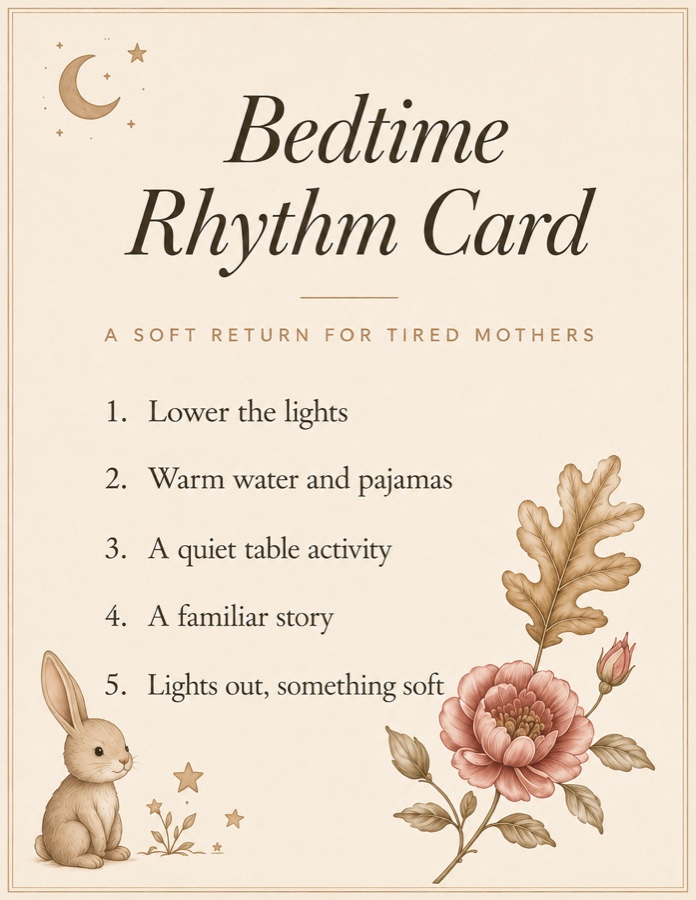
Download the Bedtime Rhythm Card (PDF)
When you subscribe to the Oak & Rose Home journal below, we’ll send it your way once it’s ready — along with a quiet note when new printables and journal entries arrive. No noise, no selling, just the small peaceful things that help.
A note for hard nights
Some nights will fall apart no matter what rhythm is in place. The toddler will scream through the bath. They will refuse the pajamas. They will fight the story. They will eventually fall asleep on the floor in the hallway.
That is allowed.
A bedtime routine is not a guarantee. It is a soft return — a familiar shape to come back to. On the hard nights, you don’t have to start over. You just have to find the next step on the rhythm card and keep moving.
The home will settle. The child will settle. The mother will settle.
— Oak & Rose Home
Common questions
Why is toddler bedtime so hard?
A toddler's nervous system at the end of the day is rarely tired in a settling way — it is overstimulated and bracing for transition. The way out is not more discipline; it is lowering the stimulation of the room itself before the child.
What time should a toddler go to bed?
Most toddlers between one and three years thrive on a bedtime between 7:00 and 8:00 pm. The exact time matters less than the consistent rhythm — the same shape every night.
How long should a toddler bedtime routine be?
About thirty to forty-five minutes from the start of wind-down to lights out. Shorter routines feel rushed and skip the body's transition signals; longer ones tend to lose toddler attention.
What if my toddler refuses the bath, the pajamas, or the story?
On the hard nights, the routine is not a guarantee — it is a soft return. Find the next step on the rhythm card and keep moving gently. Perfection is not the goal; the next quiet moment is.