
Journal
Stay-at-Home Mom Burnout: A Soft Way Back to Yourself
It does not arrive all at once. Stay-at-home mom burnout creeps in so quietly that you forget what your normal used to feel like — the laughter, the curiosity, the small clear pleasures that used to belong to ordinary days. You don’t notice it as burnout. You notice it as a low static behind everything. The noise under the laundry pile. The pause before the toddler’s third why of the hour. The tightness in your shoulders by 4 pm.
This is real. It has been most of ours. And almost no one names it correctly the first time around.
It is not because you are bad at this. It is not because you don’t love your child. It is the predictable, accumulated cost of doing emotional and physical labor that has no end-of-shift, no performance review, no metrics, and very little applause — for years.
This is a gentle map of the territory: what stay-at-home mom burnout actually feels like, the signs no one names out loud, and the soft way back to yourself.
The signs no one names
Most of what’s written about burnout is workplace burnout. The diagrams about exhaustion, cynicism, decreased efficacy — those were built for someone who works at a desk and gets to go home at the end of the day. Stay-at-home mothers don’t have that home to go to. The desk is the home.
Some of the quieter signs that are specifically yours:
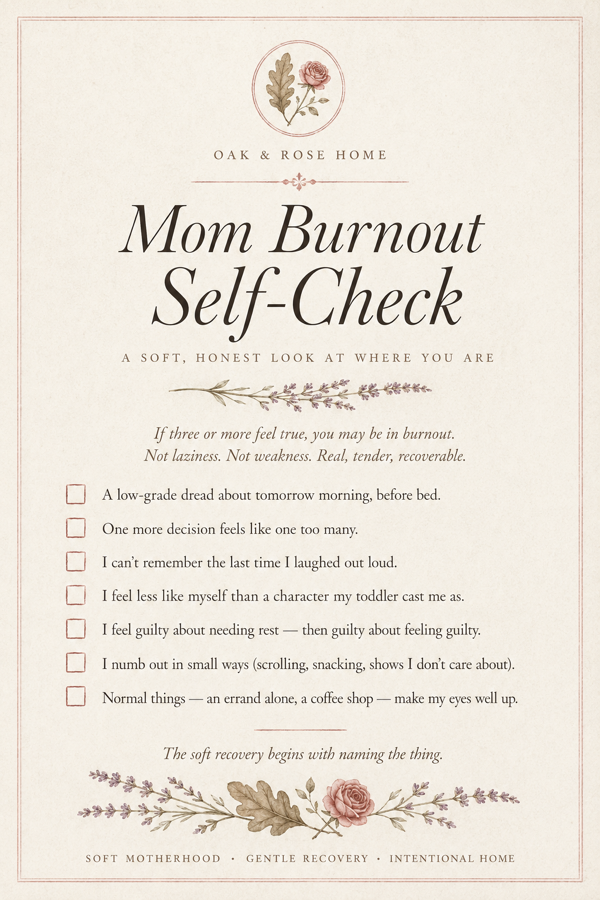
- You feel a low-grade dread about the morning before you even close your eyes at night.
- The thought of one more decision — what’s for dinner, what to wear, whether the toddler can have the cracker — makes you want to lie down on the floor.
- You can’t remember the last time you laughed at something out loud.
- You feel less like yourself than a character your toddler has cast you as.
- You feel guilty about needing rest, then guilty about feeling guilty.
- You numb out in small ways — scrolling at bedtime, snacking after the kids are asleep, watching shows you don’t actually care about.
- You imagine yourself doing very normal things — running an errand alone, sitting in a coffee shop, taking a class — and your eyes well up.
None of these mean you don’t love your life. They mean your nervous system has been running too hot for too long.
Why stay-at-home motherhood is its own kind of burnout
Three things make this kind of burnout particularly hard to spot and particularly hard to recover from.
No clear off-shift. Most jobs have a clock-out. Mothering has nap windows that vanish into sippy-cup cleanup that vanish into dinner prep that vanish into bath that vanish into the next morning. There is no clean edge between “working” and “rest.”
No external validation. The work is invisible to almost everyone. No bonus, no raise, no annual review. The toddler will not thank you for your fourth lap with the laundry. The partner often doesn’t see it. The wider world does not see it at all.
No social comparison group. Other stay-at-home mothers are doing the same job in their own kitchens, mostly alone, mostly behind closed doors. There is no shared break room. There is no easy moment to ask, “Is this normal? Are we okay?”
If you’ve read our calm motherhood reset, you know that the body sometimes registers chronic overstimulation as a separate signal. SAHM burnout is what happens when overstimulation goes on for long enough to become structural.
A soft recovery, step by step
These steps will not cure burnout in a weekend. They are the soft architecture that lets recovery happen over a season. Begin with one. Add another in a week.
1. Name what you’re feeling
Burnout isn’t laziness, weakness, or “not being made for this.” It is a real, observable, biological response to chronic overload. Saying the word out loud, even just to yourself, takes the shame out of it.
Try saying it once, gently, in your own kitchen: “I am a burned-out stay-at-home mother.” “I am exhausted in a way that sleep won’t fix.” “I am running on empty.”
Naming it does not weaken your motherhood. It begins the recovery.
2. Subtract one daily reflex that drains you
Pick one — just one — small habit that uses energy without giving it back. The phone first thing in the morning. The yes to the playdate you don’t have bandwidth for. The fifteen-minute optimizing of the toddler’s afternoon. The Instagram scroll at 9 pm.
Drop it for two weeks. Notice what comes back.
(Our journal entry on what I stopped doing when I decided to mother calmly is the longer version of this list — feel free to borrow whichever subtraction lands for you.)
3. Move your body, gently
Not exercise — movement. Five minutes outside, no goal. A slow walk around the block with the stroller. Stretching at the kitchen counter while the kettle warms. Dancing with the toddler in the living room for one song.
The body keeps the burnout score. Even small movement begins to draw it down.
4. Tell someone the truth, out loud
A friend. A partner. A therapist if you can afford one. A journal if you cannot. The sentence you have not said. “I’m not okay.” “I haven’t been okay for a while.” “I love him and I am drained, and both of these things are true.”
Burnout shrinks in language. It grows in silence.
5. Lower the bar in three places this week
This is the one no one wants to give you permission for, so consider this your permission slip:
- Dinner. Three meals this week can be cereal, eggs, or frozen waffles. Nothing is wrong.
- The toddler’s bath. Skip a night or two if it makes the evening softer. Skin will be fine.
- Anything else you can. Folded laundry can stay in the basket. The car can stay un-vacuumed. The thank-you note can wait.
Burned-out women cannot lower-the-bar their way out of burnout. But they cannot recover with the bar where it is, either.
6. Build one tiny ritual that belongs only to you
Burnout recovery, in the end, is about reclaiming the smallest amount of unclaimed time. Seven minutes before the kids wake up. Tea in the kitchen with no phone. One line written in the same notebook every morning.
Our 7-minute morning reset for mothers is the smallest version of this; pick anything that works for you. The size doesn’t matter. The fact that it is yours matters.
What recovery actually looks like
It is not dramatic. Burnout doesn’t lift in a single afternoon, the way a fever does. It lifts in tones — the small notice that the morning didn’t feel like the morning used to, the surprise of having actually wanted to be at the park instead of just been there, the moment when a friend’s voice on the phone made you laugh in a way you used to.
The toddler will still be a toddler. The day will still be a day. But the woman walking through it will be more herself than she has been in a while.
A free Mom Burnout Self-Check
We made a small printable — a one-page Mom Burnout Self-Check with the seven signs in checkbox form, soft enough to slip onto a fridge or inside a notebook. For the days when you need to look at the list and quietly tick the ones that resonate.
Download the Mom Burnout Self-Check (PDF)
When you subscribe to the Oak & Rose Home journal below, we’ll send it your way along with a quiet note when new printables and journal entries arrive.
A note for the mother in the middle
If you are reading this in the worst of it — hear this clearly: you are not broken. You are not failing. You are exactly the kind of attuned, devoted mother whose nervous system has been used too generously for too long.
Begin with one subtraction. Then a single quiet ritual. A season from now, you will look back at the woman who read this article and not quite recognize her.
The recovery is real. It is slow. It is yours. And it begins with naming the thing.
— Oak & Rose Home
Common questions
How do I know if I'm experiencing stay-at-home mom burnout?
Common signs include chronic exhaustion that sleep doesn't fix, dread about the morning before you close your eyes, struggling to remember the last time you laughed, numbing through scrolling or snacking after the kids are asleep, and feeling less like yourself than a character your toddler has cast you as. If three or more feel familiar, you are likely in burnout.
Is stay-at-home mom burnout real, or am I just tired?
It is real. Burnout is a recognized response to chronic overload — the World Health Organization classifies it as an occupational phenomenon. Stay-at-home mothers experience it at higher rates than most professions, largely because the work has no end-of-shift, no external validation, and no built-in social support.
How long does stay-at-home mom burnout last?
Without intervention, it can last months or years. With gentle, consistent subtraction and small daily rituals, most mothers notice tonal shifts within two to three weeks, and meaningful recovery over two to three months. It is slower than productivity content promises, but actually lasting.
Can I recover from mom burnout without quitting being a stay-at-home mom?
Almost always, yes. Recovery is rarely about the role itself — it is about the small daily reflexes inside the role. Subtracting one or two of them, naming the burnout out loud, and building one ritual that belongs only to you will move the needle without changing the larger shape of your life.