
Journal
Slow Summer With a Toddler: Screen-Free Rhythms, Not Crafts
Pinterest will tell you, this summer, that a screen-free season requires sixty crafts, a chalk-paint mural for the driveway, a sensory bin you have to refill weekly, and a different themed day each week of June. Pinterest is wrong, and Pinterest is also exhausting, which is partly why so many mothers reach for the iPad by mid-July despite their best intentions in May.
If you have been bracing for the next three months — the long unstructured days, the constant question of what to do with her, the low-grade guilt that you are failing some Instagram standard you never quite signed up for — there is a gentler way. It does not require crafts. It does not require novelty. It does not require you to become a children’s activity coordinator alongside everything else you are already running.
What it requires is a small set of rhythms that repeat. That is the entire system, and it is the same logic that runs every other small thing on this site — the seven-minute morning reset, the soft bedtime routine, the OLAD laundry method, the herb garden by the kitchen door. Repetition is what tired mothers can sustain. Novelty is not.
The principle: rhythms, not activities
A toddler is not, structurally, an audience that needs to be entertained. She is a small developing human being organized almost entirely by predictability. A morning that begins the same way every day, a snack at the same time, a quiet hour at the same hour, an evening that closes the same way — these are not boring to her. They are the safety that lets her brain rest enough to do its actual work, which is mostly absorbing the world.
What looks, from a Pinterest feed, like a curated summer of varied experiences is, from inside the day, what tires both of you out. What looks, from a Pinterest feed, like the same boring afternoon repeated for ninety days is, from inside the day, the kind of summer a toddler grows in calmly and a mother survives.
The seven rhythms below are not a checklist. They are a small menu. Choose three or four. Repeat them, mostly the same way, mostly every day, for three months. By August you will have a household that has settled into a quiet shape, and a toddler who needs less curation than you currently believe.
1. A morning outside hour
The day’s first anchor is outside, at roughly the same time, in roughly the same place. The porch, the yard, the same short walk around the block, the front step with a cup of coffee while she pulls grass.
The hour does not need to be active. It needs to be outside. Birdsong, sun on her skin, the visual variety of a tree compared to a wall — all of it does more for a toddler’s nervous system in twenty minutes than an hour of structured indoor play. And it does more for yours than the second cup of coffee that was the alternative.
If the weather is wrong, take it down to ten minutes. The rhythm matters more than the duration.
2. Water as the central toy
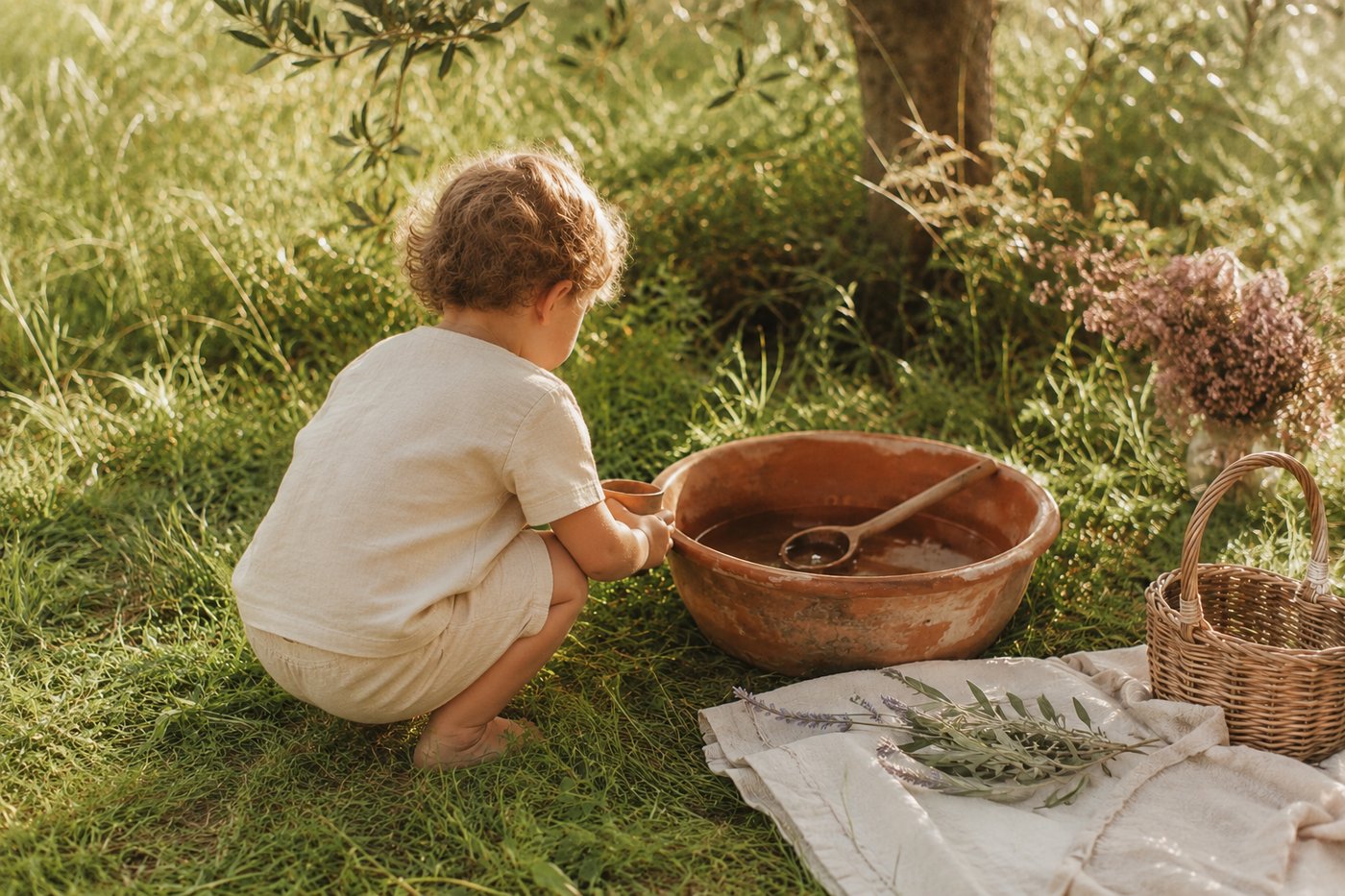
If summer has a single object that does most of the work, it is water. A shallow basin in the grass with a wooden spoon and a few small cups. A low sink in the kitchen with a step stool and a cloth. A sprinkler on the lawn. A bath at four in the afternoon when the day has been long and there is still an hour to dinner.
Water absorbs more toddler energy than any structured activity, and the only thing it asks of the mother running it is a towel. Set up the basin once, refill it the next day, replace the towel. This is the closest thing to a free hour a summer day will give you.
A second small benefit: a wet toddler is a toddler who has been thoroughly tired in the gentlest possible way. The afternoon nap, or the early bedtime, that follows a water hour is almost a guarantee.
3. A small snack ritual
Anchor one moment of the day with a small repeated snack. Same fruit, same small pitcher of cold water, same spot — the back step, the kitchen floor by the screen door, a blanket under the tree. Three o’clock works for most families; the exact time matters less than the consistency.
The snack does not need to be elaborate. A piece of fruit cut into small pieces. A handful of crackers. A small bowl of yogurt with a spoon she is allowed to wield poorly. The point is the return — the predictable interruption of the long stretch between lunch and dinner with a small ritual that says, here is where the afternoon shifts.
A snack ritual is also one of the easiest ways to give a long day a shape without doing any work.
4. A protected quiet hour
Somewhere in the middle of the day, daily, give the household one full quiet hour. If she still naps, the nap is the hour. If she no longer naps, lay-down quiet time on her bed with a few board books and a stuffed animal is the hour. Either way, the hour is non-negotiable, and it belongs as much to you as to her.
This is not a luxury. It is the structural reason a screen-free summer is survivable. Without a daily protected hour, the long stretches of toddler attention erode you steadily until late July, when the iPad reappears as a last resort. With a daily protected hour, the back half of the day becomes possible.
What you do with the hour matters less than that you take it. A book. A cup of tea. A walk through the house with no one asking anything of you. Lie down if you need to. The hour is yours.
5. One real-world task, together
Toddlers do not need most of the curated activities Pinterest will sell you. What they actually need, often, is to be near you doing your thing — and to be invited, very lightly, into the smallest possible version of it.
A single tea towel to help fold. One vegetable to wash with you at the sink. The herb pot by the kitchen door to water with a small watering can. Snipping basil with kitchen scissors while you make pasta. None of these are activities; they are participation, and that distinction is the entire point. She does not need to do it well. She needs to be near you and asked.
Five minutes a day of this kind of inclusion, repeated through a summer, will do more for a toddler’s sense of household belonging than a hundred crafts.
6. An evening outdoor moment
Mirror the morning. Close the day outside.
A short walk after dinner. Ten minutes on a blanket in the grass with a board book. Watering the front-step planters together. A small loop of the garden, naming what is flowering. The evening hour, especially in summer, is the gentlest light of the whole day — and a toddler taken outside for fifteen minutes in golden hour is a toddler who falls asleep more easily than one kept inside.
It also gives the back half of the day the same predictable shape as the front. By August, she will start asking for the evening walk on her own.
7. A bath that doubles as the evening reset
The final rhythm of the day is the bath, which does double duty: it is the toddler’s evening reset, and it is the moment that signals the day’s end for the whole house.
Run it at the same time each evening, just before dinner if she is tired, just after dinner if she has the stamina. Use it as the small transition between active day and quiet night. Pair it with the soft bedtime routine that follows, and the rest of the evening becomes the lightest part of the day.
A bath is also the only summer activity that requires absolutely no creativity from the mother running it. The water does the work.
A note on the days when nothing works
There will be days the rhythms fail. A child wakes up off, the weather refuses to cooperate, you yourself are too depleted to leave the couch. Those days will happen. They are not the system breaking. They are the system absorbing exactly what a slow summer is designed to absorb.
On those days, lower the bar to one rhythm. Get outside for ten minutes. Run the bath early. Skip the structured snack and let her eat crackers on the kitchen floor while you sit in a chair. Survive the day, not the standard. The rhythms will pick up tomorrow on their own, and they always do.
A slow summer is not built on perfect days. It is built on the long average of mostly-okay ones, repeated across three months, until the family settles into a shape that does not require you to perform.
A small place to begin
If everything on this list still feels like too much, choose one. The morning outside hour is the easiest, because most mothers already go outside in the morning anyway; the rhythm is just naming it. Take her out tomorrow, at the same time, to the same place, for the same length. Do it again the next day.
By the third week of June, you will have a summer that does not require curating. The rest of the rhythms will follow, gently, in their own time — and the iPad will quietly stay in the drawer where you put it.
If you are carrying too much
If reading this has been less about summer and more about the wider weight of being the household’s activity coordinator, emotional weather forecaster, and constant supervisor — the Reading Room is the small monthly letter written for exactly this.
One quiet Sunday a month, we send a letter from our writing desk to yours — seasonal essays, small homemaking notes, and first word on every new Oak & Rose Home release. Nothing more.
— Oak & Rose Home
Common questions
How do I entertain a toddler all summer without screens?
You stop trying to entertain her. Toddlers are organized by rhythms, not activities — a predictable outside hour in the morning, water as the central toy, a small snack ritual at three, a quiet rest hour, an evening walk. None of these require Pinterest crafts or daily novelty. Most of them are the same things, repeated. The repetition is what makes a screen-free summer sustainable for a tired mother, not the inventiveness.
What does a slow summer day with a toddler actually look like?
Slow, repeating, mostly outside. Morning porch time with a small breakfast. Water play in the yard or the kitchen sink. A snack on the back step. A quiet rest hour. A bath. Dinner. An evening walk or a few minutes on a blanket in the grass. The shape of the day matters more than what fills it. The mothers who survive a screen-free summer best are the ones who build a small, dependable rhythm and then mostly let the toddler be.
How do I avoid burnout as a stay-at-home mom over the summer?
By stopping the attempt to be an activity curator. Burnout in summer comes less from the work and more from the pressure to make each day different and special. A toddler does not need different and special; she needs predictable, calm, and outside. Pick three or four small rhythms that work, repeat them, and protect a single quiet hour each day for yourself. Sustainability is built through repetition, not novelty.
Do toddlers actually need scheduled activities?
No. Toddlers need rhythm, attachment, and unstructured space to be bored — boredom is where most of their best play actually begins. A small set of dependable anchors (outside time, water, snack, rest, walk) creates the safety they need to invent the rest. Scheduled activities, classes, and curated craft days are fine when they fit the family, but they are not what a toddler requires to thrive. Simple is enough, and often better.