
Journal
On Slow Motherhood: What It Is, What It Asks, and Why It Matters Now
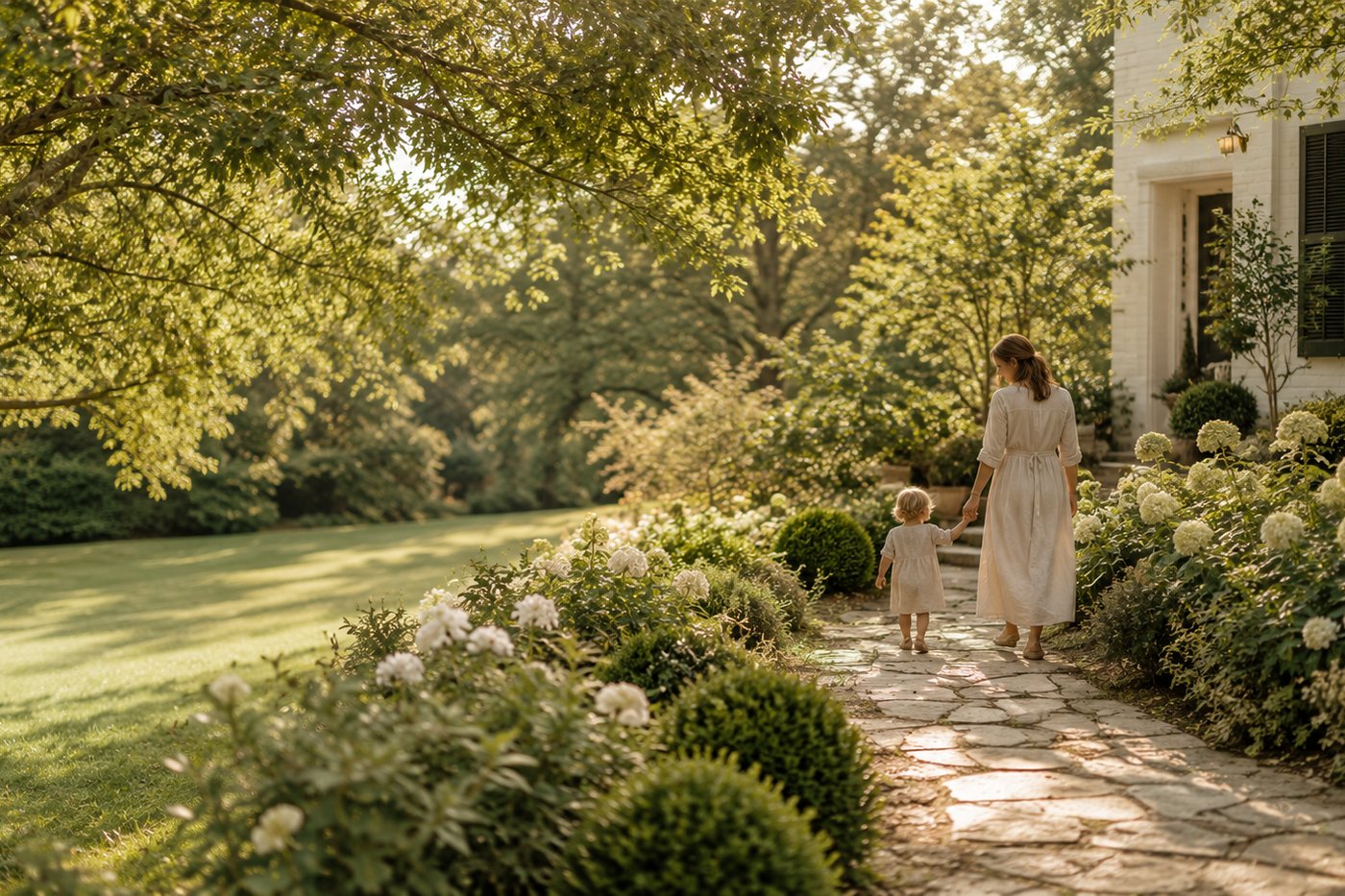
There is a morning, common to almost every house with a small child in it, when the mother stands in her kitchen with her hands wrapped around a cup of coffee that has finally cooled to the temperature she likes, and she watches her child play on the floor for ten minutes without doing a single other thing. No phone in hand. No dishwasher being unloaded with one hand. No list being mentally revised. Just a mother, her child, ten minutes of slow morning light.
For most of us, this morning is rare. Not because we don’t want it. Because the architecture of modern motherhood has been built to make it nearly impossible.
There is a name for the quiet rebellion that protects these mornings. Slow motherhood. And it is the practice this brand has decided to spend its life describing, defending, and gently teaching.
This essay is what we mean when we use the term.
What slow motherhood actually is
Slow motherhood is the practice of mothering at a pace that allows you to remain a person inside it.
It is the relinquishment of optimized motherhood — the kind that asks every minute of your day to be productive, every interaction with your child to be educational, every photograph to be Instagram-worthy, every meal to be from-scratch, and every emotion you feel about any of this to be quickly converted into either gratitude or a personal-growth lesson.
Slow motherhood says, plainly, that this is a way to lose your life inside the most precious season of it.
It is, instead, a posture. A relationship to time. A specific kind of permission you grant yourself, again and again, to do less in volume and more in attention. To let some days be small. To let some hours be unproductive. To let some afternoons unfold the way an afternoon naturally unfolds when no one is trying to optimize it.
It is, above all, a refusal of the cultural lie that the goal of motherhood is to do more — more activities, more enrichment, more documented memories, more from-scratch sourdough — until the mother herself is the only thing in the household running on empty.
A slow mother is not a tired mother. A slow mother is the mother who has decided that her own tiredness is information, not a moral failing, and has begun to build her days in a way that respects what that tiredness is telling her.
What it is not
It is worth being precise here, because slow motherhood is often confused with adjacent ideas it is not actually identical to.
Slow motherhood is not gentle parenting. Gentle parenting is a philosophy about how parents and children interact — how rules are set, how emotions are validated, how discipline is or is not administered. Slow motherhood is a philosophy about how the mother relates to her own pace and her own life. You can be a slow mother who uses traditional discipline; you can be a gentle parent who is running yourself into the ground. The two practices are compatible but distinct.
Slow motherhood is not attachment parenting. Attachment parenting is about the physical closeness of mother and infant — bedsharing, baby-wearing, extended breastfeeding. Slow motherhood is agnostic about these choices. A mother who uses a crib and bottles can practice slow motherhood beautifully. A mother who wears her toddler all day may or may not be.
Slow motherhood is not slow living applied to moms. Slow living is a broader cultural movement about consumption, pace, and presence for adults. Slow motherhood is its specific application to the unique shape of mothering — and that shape changes everything. A slow mother cannot retreat to a quiet cabin to write her novel; the work of mothering is loud, interruptive, recurring, and not optional. Slow motherhood is what slow living becomes when the practitioner also has a two-year-old who needs lunch.
Slow motherhood is not anti-ambition. It is anti-frenzy. A slow mother can be deeply ambitious — for her writing, her work, her garden, her marriage, her child’s character. What she has given up is the lie that ambition requires a constant state of overstimulated rushing.
Slow motherhood is not the Instagram aesthetic of “soft motherhood.” Beautiful homes, refined morning light, and cream linen are part of our brand’s particular articulation of soft motherhood, and we will not pretend otherwise. But the aesthetic is a vessel, not the substance. A mother in a small apartment with thrifted furniture is practicing slow motherhood the moment she watches her child play on the floor for ten minutes without doing a single other thing. The aesthetic helps the practice. It is not the practice.
The four foundations of a slow mother’s life
When we describe slow motherhood as a practice, this is what we mean she is practicing.
Margin. A slow mother builds margin into her days the way a careful gardener leaves space between her plants. She does not schedule three errands for the morning when she knows two will fit. She does not say yes to the playdate that requires her to skip her child’s nap. She does not promise the school the homemade cupcakes when she knows she has nothing left. Margin is not a luxury; it is the architecture that lets the rest of motherhood stay soft instead of brittle.
Rhythm. A slow mother lives by rhythm rather than rigid schedule. Mornings have a shape — coffee, light, the slow waking of a child. Evenings have a shape — a small tidy, a meal, a quiet ritual. The shape is not a tyrant; it is a kind of grace that removes a hundred small decisions a day. The slow mother is not flying by the seat of her dress; she has built a soft cadence underneath her week that holds her up when she is too tired to think.
Presence. A slow mother is willing to be bored beside her child. This is the practice that is hardest to overstate and easiest to underestimate. To sit with a toddler stacking blocks for fifteen minutes without picking up your phone, without folding the laundry on the side, without listening to a podcast in one ear — this is the practice of presence, and it is genuinely difficult, and it is the practice that most reliably changes the texture of a family’s life.
Restoration. A slow mother takes her own restoration seriously, not as a self-care indulgence but as infrastructure. She protects her sleep, her quiet hours, her solo walks, her reading time, her friendships, her body, her interior life. She has learned the hard way that a mother who is not being restored cannot keep restoring anyone else. The slow mother’s restoration is not an emergency. It is a constant.
These four — margin, rhythm, presence, restoration — are the foundations. Any one without the others is incomplete. Margin without presence is just empty time scrolled away. Rhythm without restoration is just a more organized exhaustion. Presence without margin is a held breath that eventually breaks. The foundations work together, or they do not work.
If you would like a sense of where you sit across the four right now — closer to the overextended end of the spectrum, somewhere in the slow work of recovery, or already rooted — the Slow Motherhood Assessment is the quiet place to find out. Twelve gentle questions, the archetype you are quietly already living, and a small personalized action plan for the season you are actually in. About five minutes; nothing required of you except honest answers.
What it asks of you
We should be honest about this. Slow motherhood is harder than fast motherhood. It just looks softer.
It is harder because nothing in the surrounding culture supports it. Your phone does not support it. Your child’s school does not support it. The pediatric developmental milestones page does not support it. The other mothers, the ones quietly running themselves into the ground, do not necessarily want you to choose differently — because your choosing differently makes their choosing differently feel possible, and possibility is its own kind of weight.
Slow motherhood asks you to disappoint people. It asks you to be the mother who declines the third birthday party of the month, the volunteer position, the side hustle, the evening event. It asks you to be the woman who is fine being a little less impressive in exchange for being a great deal more present.
It asks you to develop a relationship with your own tiredness that is not based on managing it away. The fast mother medicates her tiredness with caffeine, productivity hacks, and the promise of a future season when things will calm down. The slow mother sits with her tiredness, asks it what it is telling her, and changes the shape of her week in response.
It asks you to give up on the dream of being praised for your motherhood. Slow motherhood does not produce the kind of motherhood that other people compliment. No one comments on the playdate you declined. No one notices the morning you spent doing nothing. The praise structure of modern motherhood is built around output; slow motherhood is built around presence; the two systems do not communicate.
And it asks you to grieve, quietly and continuously, the version of motherhood you were told you should want. The Pinterest crafts you will not make. The themed birthday parties you will not throw. The educational enrichment activities you will skip. There is real grief in choosing differently than the culture trained you to choose, and the slow mother does not pretend the grief is not there. She acknowledges it, names it, and chooses again.
Soft motherhood — our particular articulation
We use the terms slow motherhood and soft motherhood almost interchangeably in our writing. There is a small difference, and it is worth naming.
Slow motherhood describes the pace. Soft motherhood describes the atmosphere that a slow mother is able to cultivate when the pace is no longer adversarial to her life.
A soft mother is a slow mother whose home has begun to carry the felt experience of her practice. There is cream linen on the table because she had time to put it there. There is a candle lit in the kitchen because she remembered to light it. There is a small bowl of garden roses on the counter because she clipped them this morning. The aesthetic is not the goal; it is the natural consequence of a woman who has stopped running long enough to let beauty in.
Oak & Rose Home is built around the practical infrastructure that supports this transition. Daily rhythm checklists. Weekly resets. Bare-minimum-day permission. Homemaking systems that serve the slow mother rather than demand more from her. We do not believe the aesthetic alone will save anyone; we believe the aesthetic is part of what a saved life can look like.
If you are reading this and you are tired — the specific motherhood-shaped tired, the one no nap can fix — we want you to know that there is another way to organize your days, and it does not require you to be someone you are not. It requires you to stop being the person the culture trained you to be, and to begin again, slowly, in the direction of your own life.
How to begin
We have written a great deal about the how in adjacent essays, and we will keep writing it. For now, the smallest version of the answer is this.
Begin with a single morning. Tomorrow morning. Make your coffee. Watch your child for ten minutes without doing a single other thing. Notice what happens in your body. Notice what happens in your child. Notice what happens in the room.
That ten minutes is the practice. Everything else is scaffolding around it.
We will help you build the scaffolding.
The Reading Room is the gentlest place to keep company with this practice — a small monthly letter designed for the soft mother, with seasonal essays and quiet homemaking notes on protecting exactly the kind of morning we just described. Not a cure. Not a system. Just company. Join the Reading Room →
But the morning is the practice.
The rest is just the help.
Common questions
What is slow motherhood?
Slow motherhood is the practice of mothering at a pace that allows you to remain a person inside it. It is a posture, not a system — a deliberate refusal of the cultural lie that motherhood must be optimized, productive, and constantly performed. The slow mother builds her days around margin, rhythm, presence, and her own restoration, in that order. She is not necessarily less ambitious than the fast mother; she is less frenzied. The practice asks her to do less in volume and more in attention, and to stop measuring her motherhood by the output it produces.
How is slow motherhood different from gentle parenting?
Slow motherhood and gentle parenting are compatible but distinct. Gentle parenting is a philosophy about how parents and children interact — how rules are set, how emotions are validated, how discipline is handled in real time. Slow motherhood is a philosophy about how the mother relates to her own pace, her own life, and her own restoration. A mother can practice both, one, or neither. They live in different rooms of the same house. Gentle parenting governs the interactions with the child; slow motherhood governs the architecture of the mother's life around those interactions.
Can you practice slow motherhood with multiple young children?
Yes. Slow motherhood with multiple young children is harder to begin with, because the demands are denser and the margin smaller. But the practice is the same. The slow mother of three is still building margin (smaller pieces of it, more carefully protected), still living by rhythm (which becomes even more important with more children, not less), still practicing presence (often with one child at a time, in rotation), and still taking her own restoration seriously. Some seasons in a large family will require more output than slow; the slow mother accepts this and protects the restoration to match. The practice is not about avoiding all output. It is about not letting the output consume the mother.
Is slow motherhood the same as being lazy or unambitious?
No. Slow motherhood is one of the more demanding practices a modern mother can choose, precisely because nothing in the surrounding culture supports it. The slow mother is not lazier than the fast mother; she is making a much harder set of choices, repeatedly, against the grain of every default. She declines invitations, refuses extracurricular pressure, protects her sleep against the productivity culture, and accepts being a little less impressive in exchange for being a great deal more present. Ambition can live inside slow motherhood — for her writing, her work, her marriage, her garden, her child's character — but it is the kind of ambition that is built underneath, slowly, over years, not the kind that is performed daily for an audience. Slow motherhood is the opposite of lazy. It is just quieter.