
Journal
A Stress-Free Father's Day Plan for Tired Mothers
Father’s Day, in most homes, is quietly run by the mother. She remembers the date. She buys the card, helps the children make the handprint, plans the brunch, schedules the call to her father-in-law, picks the gift, frames the photo, and orchestrates the small set of moments that the father will, hopefully, get to experience as effortless. By Sunday evening she is tired in a particular way that no one quite acknowledges — including herself.
If you have been quietly bracing for this — the planning, the cooking, the curating, the low-grade pressure to make June 21 feel like something — there is a gentler way through the day. It does not require a brunch reservation. It does not require Pinterest crafts. It does not require you to become a small holiday coordinator alongside everything else you already coordinate.
What it requires is a stress-free plan, written by the mother running it, for the mother running it. Because here is the small truth of Father’s Day in households where the mother does most of the labor: the stress-free day she plans for her family is the same day she actually gets to live in herself. The reframe is the entire plan.
The reframe: stress-free for you is the gift
Most Father’s Day content treats the day as an opportunity to perform thoughtfulness — a brunch spread, a curated experience, a perfectly-styled photograph of children handing over a card. None of those things are bad. They are also not what most fathers actually want, and they are emphatically not what the mother running them wants either.
The honest version of Father’s Day, asked directly, looks like this: most fathers want a quiet morning, a meal they like, time they did not have to schedule themselves, and the small sentimental anchor of a child’s handprint or handwritten note. None of that requires production. All of it requires permission — yours, given to yourself, to plan a small day instead of a curated one.
What follows is a slow Father’s Day rhythm, broken into four small anchors. The whole day, end to end, takes less effort to run than a typical Sunday brunch. That is the point.
1. The night before: subtract
The single most important step of a stress-free Father’s Day happens the night before — and it is mostly a process of removing things from the day, not adding them.
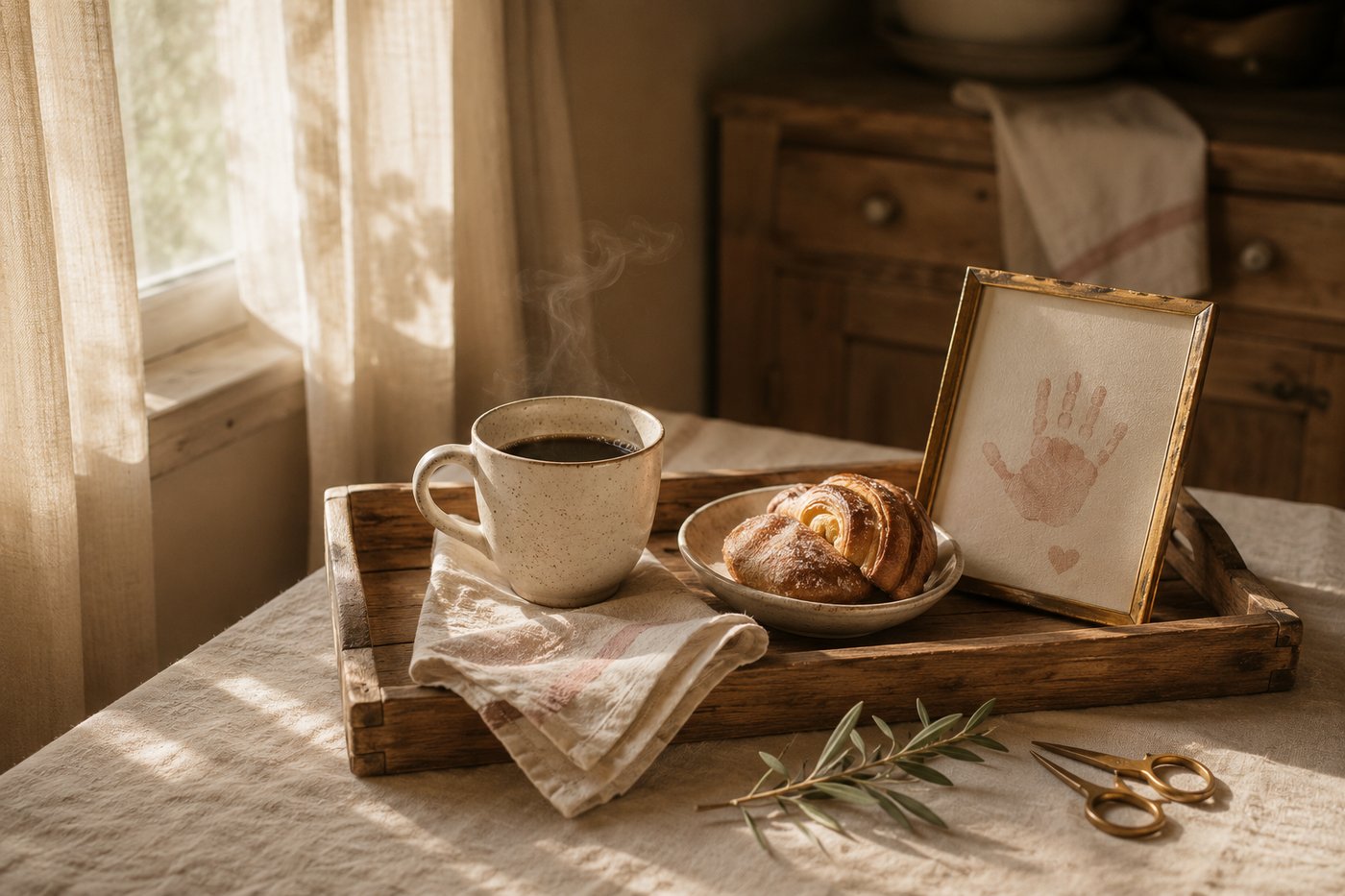
Tidy the kitchen as you would for any Sunday. Set up the coffee maker so the morning starts without thought. Lay out a small wooden tray with a folded napkin and a single sprig of greenery — the morning ceremony’s quiet anchor. Set out the small handmade card the children helped you make earlier in the week. (If you have not yet made one, you can download the free Father’s Day handprint printable and have the children do it on Saturday afternoon in ten minutes.)
Then close the night. Do not look up brunch recipes. Do not draft a schedule. Do not lay out three different gift options. The day begins tomorrow, and most of the work is already done.
2. The morning: let him surface
The single most generous thing a household can give its father on Father’s Day is the rare gift of waking up to a quiet house.
No alarm. No early scheduled breakfast. No staged opening of cards. If the children are old enough to keep themselves entertained for an hour, take them quietly into the kitchen and make a slow breakfast for the two of you while he sleeps. If they are not, take the morning slow at his bedside with a board book and a basket of toys. The house is allowed to be quiet for as long as he needs it to be.
When he surfaces — whenever that is — the morning ceremony is small and short. The children deliver the mug of coffee, slightly sloshing, to wherever he is sitting. They hand him the small handprint card. He says thank you, ruffles a small head, and drinks his coffee while it is still hot. The whole sequence takes two minutes. It is more than enough.
The handprint card itself is, structurally, the gift of the entire day. It costs nothing, takes ten minutes for a toddler to make, and tends to be the one thing fathers quietly keep — slipped into a drawer the night you give it, framed on a shelf years later, pulled out long after the brunch is forgotten. Our free Father’s Day handprint keepsake printable was designed exactly for this morning — the small kind of gift a father actually cherishes, paired with the slow morning he actually wants.
This is the morning a father remembers — not because of its scale, but because of its quiet.
3. The meal: one thing he actually likes, simply
The Father’s Day brunch trap is real. The pressure to produce a multi-component meal — eggs benedict, fresh pastry, a board of charcuterie, a mimosa pitcher — turns a holiday into a half-day cooking project, and the mother running it is the one who pays.
Subtract here too. Pick the one meal he actually likes — not the one Pinterest tells you to make. A breakfast sandwich. Pancakes from a mix. Cinnamon rolls from the tube on a beautiful plate. Coffee with cream. A lunch of his favorite sandwich and good chips. Brunch from a bakery, brought home and arranged on a small tray with a cream linen napkin.
Honest cooking, beautifully arranged, beats performed cooking every time. And whatever you can prep the night before — proof the dough, chop the herbs, set the table — is one less Sunday-morning decision you have to make. This is the same gentle logic that runs the slow Sunday reset, applied to a Sunday that happens to also be a holiday.
4. The afternoon: give him real rest
Here is the actual gift of Father’s Day, the one most plans accidentally remove: an afternoon of unstructured, unscheduled, unsupervised time.
A nap. A book in the yard. A long shower. A drive somewhere alone. A garage project he has been putting off. A movie he wants to watch without small commentary. Whatever quiet looks like for him, for two or three hours, with no one asking anything of him.
The way to deliver this is simple, and it is the part of the plan most likely to surprise the mother reading it: take the children out. A walk to the park, a slow loop of the neighborhood, ice cream from the small shop, a low-stakes errand. Ninety minutes outside the house, and the house becomes the gift.
There is a small secret tucked inside this step: the walk is also yours. A Father’s Day afternoon that includes a quiet walk for the mother — with a toddler in the stroller, a coffee in hand, the small reprieve of being outside without coordinating anything — is, structurally, also a Father’s Day for her. The day is small enough that both of you can rest inside it.
5. The evening: a small ritual, not a finale
The end of a stress-free Father’s Day is not a third meal of high effort. It is a small ritual that closes the day on an exhale.
A favorite drink — a beer he likes, a glass of wine on the back step, an iced coffee — taken outside while the children play. A candle lit at the kitchen table. Dessert from the bakery instead of made. A short walk around the yard before the bath-and-bed sequence begins. The point is not to add a third event to the day. The point is to mark the day’s end with one small calm gesture, and then let the regular evening rhythm carry you home.
If the children have made a second small card or drawing in the afternoon, this is the moment to deliver it. A handmade scrap of paper at the end of a quiet day is, somehow, more moving than the morning’s ceremony — perhaps because by evening the day has earned it.
A small note on the resentment trap
There is a particular flavor of Father’s Day exhaustion that has more to do with mothering than with cooking — and it is worth naming. If you have spent the day orchestrating his rest while your own went unacknowledged, by Sunday evening you may find yourself quietly, unfairly resentful. This is not a failure on your part. It is the predictable result of a household where one parent’s holiday is run by the other.
The defense is the plan itself. A small day for him is also a small day for you. The walk you take with the children in the afternoon is your reprieve. The unmade brunch is your morning gift to yourself. The dessert you didn’t bake is the choice that protects your Monday. If you find yourself stretching the plan back into a production — adding a brunch course, an elaborate dinner, a curated activity — pause. Subtract again. The plan only works as long as it stays small.
A small place to begin
If everything above feels like still too much, choose three things. The slow morning (no alarm, coffee delivered, handprint card). The one simple meal he likes. The afternoon walk that takes the children out of the house.
That is the whole plan. The other steps will fall into place around them or fall away entirely — and either is fine. The point of a stress-free Father’s Day is not to execute a perfect rhythm. It is to make the day small enough that everyone in the house, including the mother, gets to rest inside it.
If you are carrying too much
If reading this has been less about Father’s Day and more about the wider weight of being the household’s holiday coordinator, weather forecaster, and emotional logistician — the Reading Room is the small monthly letter written for exactly this.
One quiet Sunday a month, we send a letter from our writing desk to yours — seasonal essays, small homemaking notes, and first word on every new Oak & Rose Home release. Nothing more.
— Oak & Rose Home
Common questions
How do I plan a stress-free Father's Day at home?
By doing less, earlier. Pick one meal he loves and prep what you can the day before. Skip the curated activities and let the day unfold around three small anchors: a slow morning, an unstructured afternoon of real rest for him, and a low-effort evening ritual. The mother who orchestrates a stress-free Father's Day is the one who decides, the night before, that the day will be small.
What can I do for my husband on Father's Day if he doesn't want gifts?
Give him the day itself. A quiet morning without an alarm, a meal he actually likes, an unstructured afternoon of rest, and a small low-effort dinner. Most fathers, when asked honestly, want time more than they want objects. A handmade card from the children adds the small sentimental anchor; everything else can be removed without diminishing the day at all.
How do I keep Father's Day from becoming all about me running it?
By orchestrating the day from a place of subtraction, not addition. Decide the night before what will not happen: no big breakfast production, no curated brunch, no themed activities. Pick three small things instead — coffee delivered by the children, one meal he loves, an afternoon of true rest — and stop there. The smaller the plan, the more the day actually feels like a gift to him.
What is a meaningful Father's Day idea for a family with a toddler?
The simplest possible morning ceremony: a toddler walking a mug of coffee slowly across a room, and a small handmade handprint card she helped you make. Our free Father's Day handprint printable is designed exactly for this — a small keepsake gift, made in ten minutes, that fathers tend to quietly keep for years. Beyond that, give him an unstructured afternoon while you take the toddler out for a walk. The handprint is the keepsake he cherishes; the quiet afternoon is the real gift.