Journal
My First Fall Learning: A Gentle Toddler Activity Page
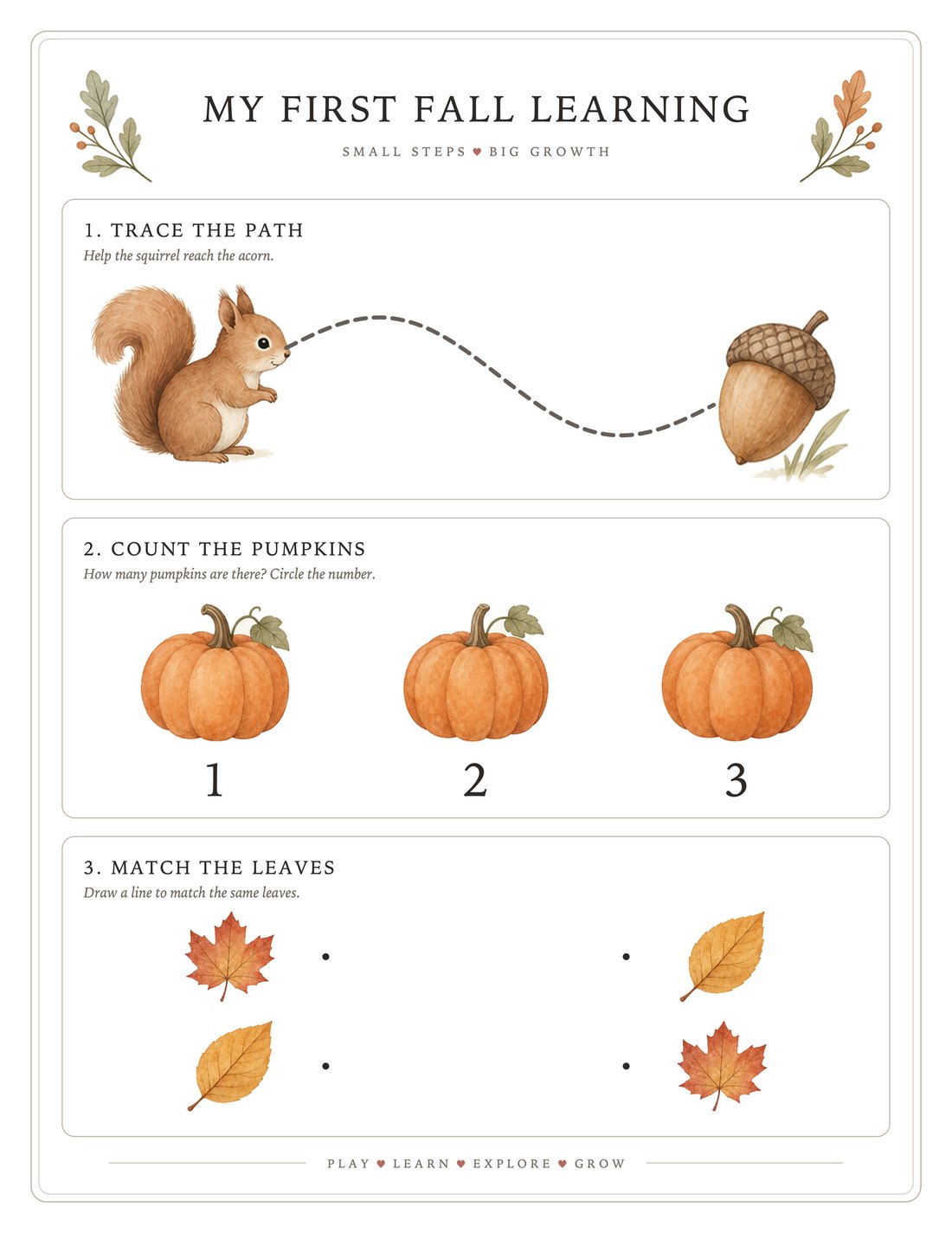
Some of the most beautiful moments of childhood happen at small tables in the morning light. A cream-painted kitchen. A small dish of coloring pencils in warm autumn tones. A folded linen napkin doubling as a placemat. And in front of a small pair of hands, a single page — painted, not printed — that gently asks the little one to notice the season through a squirrel, three pumpkins, and a small handful of leaves.
This is what soft first-learning looks like — and it is quietly returning to the homes of the mothers who have grown weary of primary-colored worksheets and bright cartoon graphics.
Get My First Fall Learning free — add your email below →
My First Fall Learning is the first small learning piece in the Oak & Rose Home library — a soft watercolor activity page designed for toddlers between roughly eighteen months and three-and-a-half years old. Three tiny activities: trace the squirrel’s path to the acorn, count three warm autumn pumpkins, and match two pairs of small leaves. Painted in the same heritage palette as our wall art — muted rust, warm ochre, dusty cream, deep taupe — on warm cream paper, framed by the same thin refined border you would find on an antique stationery card.
Why Soft First-Learning Is Having a Moment
For the last two decades, toddler learning printables have looked the same. Bright primary colors, thick outlined cartoon animals, sans-serif bubble letters, cluttered layouts with a task in every corner. The design language borrowed from classroom bulletin boards and preschool workbook covers. It works — small children respond to bright color — but it also carries a tone that is unmistakably institutional. It is the visual grammar of the daycare classroom, brought home in printed form.
What has begun to quietly shift, especially in Montessori-inspired homes and gentle-homeschool corners of the internet, is a return to a slower, softer visual language for the very earliest learning materials. Muted watercolor illustrations. Refined serif typography. Generous whitespace. One or two ideas per page, not seven. The page reads less like a worksheet and more like a small illustrated page torn out of a beautifully bound children’s book from another century.
My First Fall Learning was designed squarely inside this softer aesthetic. If your home reads as cream-painted, refined, warm, and quiet — and if you have been searching for a first-learning piece that will not visually shout at your toddler from across the kitchen table — this is the page written in the same visual language as the rest of your home.
The Three Small Activities
The page is deliberately small in scope. Three activities, not ten. Each one chosen for a specific developmental moment in the second and third year of life.
Trace the Path
At the top of the page, a soft watercolor squirrel sits opposite a warm brown acorn, connected by a gently curving dotted line. The little one is invited to trace the path — first with a fingertip, then with a crayon — from squirrel to acorn.
This is early pre-writing work in its softest form. Following a curve with the eye and the hand, without any letter shapes yet, builds the small muscle memory a toddler needs long before formal handwriting begins. Wrap it in a warm story — the squirrel is bringing the acorn home for winter, will you help her find the way? — and the small learning moment becomes a small moment of care.
Count the Pumpkins
In the middle band, three warm heritage pumpkins sit side by side above the numerals one, two, and three. Count together, out loud, pointing to each pumpkin as you name it. Then invite the little one to circle the number three.
Counting to three is a real developmental milestone — the moment a toddler moves from repeating number-words to actually attaching them to objects. The page gives that milestone a soft, small stage. Three is a beautiful number to begin with. It is enough to feel like counting; it is not so many as to overwhelm.
Match the Leaves
At the bottom, four leaves are scattered — two maple leaves in warm rust and two oak leaves in soft ochre. The little one is invited to draw a gentle line between the two that match.
This is the earliest form of visual discrimination — the same skill that will later become sorting laundry, matching pairs of socks, noticing that two apples are the same variety and two are different. Beginning with autumn leaves means the small learning moment doubles as a small noticing moment, a way to see that the world outside the window has different kinds of trees, and that each kind wears its own shape.
Who It Is For
My First Fall Learning is written for the mother who wants first-learning to feel like a small ritual, not a task.
For the Montessori-inspired mother, the page is a soft printable that fits comfortably beside a wooden Practical Life shelf and a small basket of natural objects. It preserves the muted palette and refined typography that Montessori materials have always leaned into, and it introduces early pre-writing, early counting, and early visual discrimination in a way that respects the child’s developmental readiness.
For the gentle-homeschool mother of a toddler, the page is a first small answer to the question, what should we do together this morning? Ten minutes at the kitchen table with a page painted in the same visual language as the rest of your home. No worksheet stack. No plastic bin of manipulatives. Just one small piece of paper and a warm autumn moment.
For the modern preschool teacher whose classroom leans natural — the wooden shelves, the linen bins, the cream-painted walls — the page is a small handout that will not visually clash with the room you have carefully built. Print a small stack, keep them in a soft folder on the seasonal shelf, and hand one to each child on the morning of the first autumn cold.
For the grandmother who wants to keep a small file of quiet activities for the grandchildren who come to visit on autumn Sunday afternoons, the page becomes a small keepsake in the making. Print, save, do it together, and slip the finished page into a small ribbon-tied folder marked simply the autumn we spent together.
How to Use It Beautifully
Print the page at home on heavy matte presentation paper or standard 8.5×11 letter paper — cream or warm-white suits the watercolor palette especially beautifully. If you would like a slightly more heirloom feel, print on a warm ivory cardstock.
Set a small table beside a window with morning light. A folded linen napkin as a placemat. A small dish of crayons or wooden coloring pencils in autumn tones — muted rust, warm ochre, soft cream, deep taupe. A slim wooden pointer or a favorite pencil for tracing. That is the whole setup.
Sit beside the little one, not across from them. Point to the squirrel and tell the small story before the tracing begins. Let the counting be slow, and count out loud so the little one can echo you. Let the matching be soft — draw one line together, then invite them to try the second one on their own.
When the page is finished, tuck it into a small keepsake folder for the year, or clip it to a low shelf with a small wooden clip for the season. Every so often, print a fresh page and do it again. Small hands change quickly. The line the little one traces at nineteen months will look nothing like the line they trace at twenty-eight months, and both are worth keeping.
If you love this idea, you may also love The Art of Soft Homemaking — the essay behind the design philosophy that quietly shapes every Oak & Rose Home piece, from the wall art to the small learning pages. And when the season turns, My First Christmas Learning brings the same three small activities to a little deer, ornaments, and stockings — with The Little Learning Pages for every ordinary morning in between.
A Quiet Word About the Brand
Oak & Rose Home is a vintage feminine heirloom paper goods company for women who want to live life beautifully and intentionally — designing refined printables, wall art, home essentials, and now small first-learning pages for the mothers who want their homes to raise their children in the same visual language they have built for themselves. Every piece is created with the same restraint: warm cream paper, soft heritage palette, refined typography, generous white space. The intention is for each piece to feel less like a product and more like something that has always been there.
My First Fall Learning is the first piece in a small collection of gentle first-learning pages — and it is free. Add your email below, and the printable will be waiting for you on the next page.
Download My First Fall Learning free →
A Closing Thought
The very first learning does not need to look like school. It can look like a small table by a window, a warm autumn morning, a page painted in soft watercolor, and a little pair of hands learning what a curve feels like on paper for the very first time.
If you have been waiting for a first-learning piece that finally fits the way your home already feels, this is the one.
— Oak & Rose Home
Common questions
What age is My First Fall Learning designed for?
It is designed for the small window between eighteen months and three-and-a-half years — the age when a toddler is starting to hold a crayon with intention, count small groups of objects, and notice that two of a thing look the same. Older preschoolers still enjoy the page as a warm autumn moment, but the three activities were chosen specifically for the little ones just beginning.
How is this different from a typical worksheet?
It is painted, not printed. The pumpkins, leaves, squirrel, and acorn are soft watercolor illustrations in heritage autumn tones — muted rust, warm ochre, dusty cream — rather than the primary-colored cartoon graphics on most preschool worksheets. The typography is refined serif rather than bubbly sans-serif. The intention is that the page feels less like a school handout and more like a small heirloom activity card from a beautifully bound children's book.
Do I need to laminate the page or provide any special materials?
No — the page is designed to be used once, gently, and then either kept in a small keepsake folder or hung on a low shelf for the season. If you would like to reuse it across multiple little ones, you can absolutely slip it into a soft page protector or laminate it and use a dry-erase marker instead of a crayon. Most parents simply print a fresh page whenever a small learning moment arises.
Can I print this at home?
Yes. Print at home on the highest quality your printer offers, on standard 8.5×11 letter paper or heavier presentation paper for a more heirloom feel. Cream or warm-white paper suits the watercolor palette especially beautifully, but a soft white also looks lovely.