
Journal
How I Started a Blog as a Stay-at-Home Mom (And Why I Chose Slow Growth Over Hustle Culture)
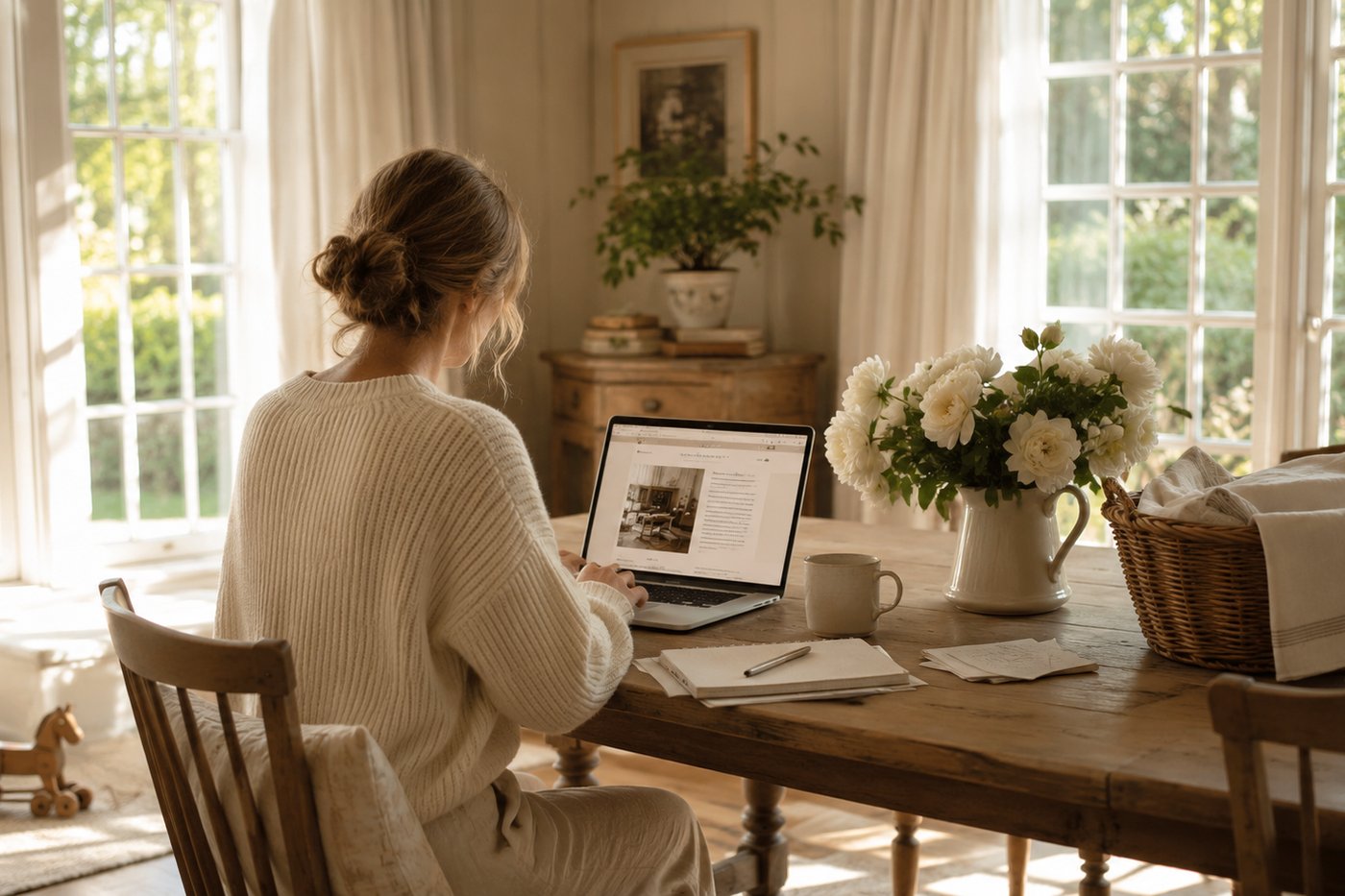
The desire usually arrives in the quietest possible way. A Tuesday afternoon, a toddler napping, a kitchen finally tidy, a mother standing at her counter with a second cup of coffee — and a small persistent feeling that she might want to make something of her own.
Not a side hustle. Not a passive income empire. Not the kind of project she would build a business school case study around. Just a place. A place to write the thoughts she has all day with no one to share them with. A place to gather what she is slowly learning about keeping a home, raising a child, growing herbs on her windowsill, baking the bread her grandmother used to make. A place that is hers.
If you are that mother, this essay is for you. I was at a similar place three years ago, a stay-at-home wife standing at my own counter with my own second cup of coffee, and what I will tell you here is the truth of how I started Oak & Rose Home from inside the small hours of my actual life — and why, against most of the advice the internet would have given me, I chose to grow it slowly.
This is not a “start your blog and quit your job by Christmas” article. There is no countdown timer at the bottom of this page. There is no course about to launch. There is only one mother, speaking honestly to another, about how a creative project can quietly become one of the most steadying things in a season of motherhood — and how to begin it in a way that respects the actual shape of a homemaker’s days.
Let me start with the question I get asked most.
Can stay-at-home moms start blogs?
Yes. And the question is more honest than it sounds.
When mothers ask me this, they usually mean five different things at once. Do I have the time? Do I have anything worth saying? Will the technical side be too hard? Will I actually be able to follow through? Will my husband or my mother or my friend think I am being silly? All of these are fair questions, and all of them have the same answer underneath: yes, but only if you let the blog be smaller than the internet has trained you to expect.
On time. A blog does not require you to have hours. It requires you to have moments — and motherhood produces moments constantly. The morning a child takes a long nap. The Sunday afternoon her father takes her to the park. The half-hour between dinner and the bath when no one is asking you anything. If you can collect three or four of those moments a week and put them toward your writing, you have enough. I drafted most of my first dozen posts in twenty-minute increments while a toddler ate yogurt.
On having something worth saying. This is the worry that holds the most mothers back, and it is also the one I want you to set down first. You have spent years observing the rhythms of a home, raising a small human, watching seasons turn through a kitchen window, learning what works and what does not work in the actual practice of running a household. That body of knowledge is enormous. Most of it has never been written down by anyone living it. There is, right now, a woman searching the internet for the exact thing you learned last Tuesday — and she will find it from someone else if you do not write it.
On the technical side. It is much easier than it was ten years ago. Buying a domain takes ten minutes. Setting up a basic website takes an afternoon. The learning curve on the actual platforms is gentle now in a way it was not even five years ago. You do not need to know how to code. You do not need to be “good with computers.” If you can manage a school enrollment form online, you can manage a blog.
On putting yourself online. This one I want to address with more care, because it is real. Choosing to write publicly as a mother carries a different weight than choosing to write publicly as someone without a child. I will say: you do not have to show your face. You do not have to use your full legal name. You do not have to share your children’s names or photographs. I have written for a while now without ever putting my child’s name on the internet, and the brand has grown anyway. You can decide what is private and what is shared, and your private choices stay protected.
On following through. This is the only one of the five worries that genuinely deserves to be a concern. Not because mothers are unreliable — they are the most reliable people I know — but because the conditions of motherhood mean that any creative project will get interrupted, delayed, and asked to wait. The way you make a blog survive those interruptions is to build it slowly, with a low enough cadence that the slow weeks do not kill it. We will come back to this.
If you are asking the question, the answer is yes.
Why blogging is a beautiful hobby — even before it becomes a business
I want to make a case here that the rest of the internet rarely makes.
You do not have to start a blog to make money. You can start a blog because it would be a beautiful hobby, in the same way that gardening is a beautiful hobby, or sewing, or baking sourdough, or restoring an old chair. The act of writing — of refining a thought until it lives clearly on a page, of putting that page out into the world and watching another person quietly recognize herself in it — is its own reward.
I had been writing for almost a year before I made my first dollar. That year was not wasted. It was the foundation. Writing without commercial pressure taught me what my actual voice sounded like. It taught me what I was actually interested in. It taught me to sit with a sentence until it was right, instead of grabbing the first cliché the internet had trained me to use. The brand voice that Oak & Rose Home now has — the literary, refined, slow-living voice that some readers tell me feels like a small balm at the end of a long day — was forged in that first quiet year when no one was reading.
If you let yourself do this without monetary pressure for the first six to twelve months, you will produce better work, you will not burn out, and you will be in a much stronger position when monetization eventually arrives. Monetization arrives, by the way, much more reliably for the bloggers who built well first.
There are other quieter gifts.
Writing about your life teaches you to notice your life. The mother who writes one essay a week about her week becomes, after a year, a mother who has paid attention to fifty-two of her own weeks in a way that nothing else would have asked her to. The internet has trained us to consume; sitting down to create reverses the flow. You will find yourself remembering what your child wore on a Tuesday in October because you were planning to write about how the leaves looked that morning. The act of looking-in-order-to-write makes a slow homemaker out of you, by the work of it.
And there is the matter of helping other women. The internet is full of mothers trying to figure out how to do the things you have already figured out — how to fold a fitted sheet, how to keep cut flowers fresh, how to talk to a toddler about big feelings, how to make a bedtime routine that actually works. Every essay you publish is, potentially, the answer to her quiet question. There are few small acts of usefulness more lasting than the right essay finding the right reader at the right hour.
If a blog never makes you a single dollar, but it gives you a writing practice, a more attentive relationship with your own life, and the occasional letter from a reader saying you helped her — it has done enough.
How I started my blog
This is the part most readers want, so let me give it to you cleanly. Six steps. None of them require expertise.
Step one — choose a niche, but choose it gently. A niche is just the territory your blog covers. Mine is soft homemaking and slow motherhood; yours might be small-batch baking, or gentle gardening for beginners, or homeschooling without burnout, or any other thing you genuinely care about and have something to say about. The mistake most new bloggers make is choosing a niche based on what makes the most money instead of what they would happily write about for ten years. Do not do that. Choose the niche you would not stop writing about even if no one paid you. The money follows depth; depth comes from genuine interest.
Step two — buy your domain. A domain is the address — oakandrosehome.com is mine. You buy it from a domain registrar (I use Cloudflare; Namecheap also works). The cost is around twelve to fifteen dollars a year. Pick a name you can imagine still loving in ten years. Avoid your child’s name (children become teenagers and dislike this). Avoid trendy words that will date. Lean toward warm, simple, evocative names. Say it out loud before you buy.
Step three — build the website. You can use WordPress, Squarespace, or any modern site builder. I built mine in a slightly more custom way because I had some technical background, but the truth is the platform matters less than the writing. A beautiful WordPress site with a thoughtful theme costs about a hundred dollars a year and will serve you well for the first three years of your work. Do not let the technical decision become a year-long delay. Pick the platform a friend you trust recommends, and start.
Step four — write your first article. Write the article you most wish someone had written for you a year ago. Not the article you think will rank highest on Google. The article a younger version of you needed. Write it long. Edit it carefully. Add your photographs if you have them. Publish it. There — you are a blogger.
Step five — make Pinterest pins. Pinterest is the kindest social platform to new bloggers because the platform does the discovery work for you. You do not need followers; you need pins that solve real readers’ problems. Make two or three Pinterest pins for your first article, save them to a board, and let them work for you while you write the next article. We have a great deal more to say about Pinterest in other essays.
Step six — learn as you go. Do not take a course before you have written ten articles. Do not buy a planner before you have written five. Do not consume blogging content as a substitute for producing blogging content. The most common mistake of new bloggers is over-consuming under the comfortable illusion that they are “preparing.” Write first. The teachers will be there when you actually need them.
That is the whole start. Domain, website, first article, pins, repeat.
The biggest mistakes new bloggers make
I have made all of these. Most successful bloggers I know have made all of these. They are nearly universal and they are nearly all curable. Naming them is the first cure.
Perfectionism. The first version of your blog will not be the best version of your blog. The first article will not be your best article. The first photograph will not be your best photograph. This is true for every single blog in existence. The bloggers who succeed are the ones who publish anyway, because they understand that finishing is the prerequisite for getting better. Perfectionism is a form of fear — the fear of being seen as anything less than excellent. The cure is to publish at seventy percent and trust that the next post will be at seventy-two percent, and the post after that at seventy-five percent, and that the readers who arrive at you in a year will be reading a writer who has earned the eightieth percentile by simple repetition.
Niche hopping. New bloggers, anxious that they have chosen wrong, start a blog about homemaking, get discouraged after six weeks of slow traffic, and pivot to mom hacks, then to parenting tips, then to slow living, then to fitness, then back to homemaking. Each pivot resets the work and resets Google’s understanding of what the blog is about. Pick a niche, and give it eighteen months before you change your mind. Most blogs that seem to have failed actually quit just before the moment they would have grown.
Comparison. The bloggers you admire on the internet are not at your stage. They are five years ahead of you, or ten, or they were doing this professionally before they had children, or they had ten thousand dollars to spend on a launch designer that you do not need. Comparing your beginning to their middle is a way to lose your nerve. Read them to learn, never to measure. The only blogger you should be measuring yourself against is the version of yourself who started.
Expecting immediate results. A blog at six months does not look like much. A blog at twelve months looks like a little something. A blog at twenty-four months starts to look like a real thing. A blog at thirty-six months looks like the kind of thing the woman next door tells her sister about because the writing changed her actual week. This is the timeline. If anyone has promised you faster, they were either selling you something or lying about their numbers.
Consuming more than creating. This is the deepest of them. The internet is full of blogging-about-blogging content, and it is comforting to consume because it feels productive. It is not productive. It is the opposite of productive — it is the activity that feels like work while preventing the actual work. The rule I gave myself in my first year: for every hour I spent reading about blogging, I would spend three hours writing my own blog. If you cannot maintain a three-to-one ratio of writing to learning, you will not write enough to grow.
Why slow blogging works
I want to give a name to the approach I took, because giving it a name makes it easier to choose.
Slow blogging is the practice of building a blog at a sustainable pace, over a long enough horizon to compound, with a quality bar that does not break the writer. It is a deliberate refusal of the “post-a-day-monetize-by-month-six” model that the rest of the blogging internet promotes — a model that, for a mother with a small child at home, is closer to a guarantee of burnout than a guarantee of success.
The slow blogger publishes one article a week. Sometimes two. Sometimes — because she is a mother and the stomach flu has come through the house — none. She does not measure her success by the number of posts but by the quality of the posts she has built up over time. She knows that one essay that genuinely changes a reader’s week is worth more than fifty posts that no one finishes reading.
She has decided she would rather build slowly for five years and have something durable than build frantically for fifteen months and quit. She is right. Most of the bloggers who have lasted long enough to make a meaningful living from their writing got there by being patient when the early traffic numbers were small.
Consistency matters more than intensity. One article a week for a year is fifty-two articles. Fifty-two thoughtful articles is more than enough to make a blog a real thing on the internet. The trick is the year.
Helpful content beats clever content. A post that solves a real problem — how to keep cream blooms fresh longer, how to fold a fitted sheet, how to talk to a toddler at the end of a hard afternoon — earns the long compounding traffic. A clever take that makes the writer feel briefly seen gets a few quick shares and then disappears. Lean toward useful.
Let growth compound. The blog at six months feels like a failure. At twelve months it looks like a small something. At twenty-four months it starts to surprise you. The numbers do not move in a straight line; they move in a hockey stick, and the hockey stick is invisible until you are on the back half of it. You cannot rush the front half. You can only commit to staying.
Play the long game. The internet — and Pinterest, our primary growth channel — rewards bloggers who have been doing this for a long time. Domain age, archive depth, link history, evidence of consistency: all of this matters more than any single tactic. You are not behind. You are at the beginning of a horizon most people will not stay on. That is your advantage.
How blogging fits into homemaking
This is the part I most want to make clear, because it answers a worry I had at the very beginning.
A blog is a homemaking project. Not a separate, competing thing — a homemaking project of its own kind. Writing about the home, the seasons, the small rhythms of a family’s life, deepens the practice of homemaking. You begin to notice what you would have moved through without noticing. You begin to plan for beauty because you want to write about it. You begin to keep your home in a way that has a small audience of you-and-your-future-readers in it, and that audience is gentler than it sounds — it asks you to pay attention, not to perform.
A creative practice belongs in a homemaker’s life. Women have always made things — quilts, jam, gardens, letters, embroidered linens, written journals, watercolors of the children. The blog is a contemporary continuation of that tradition, with the small added grace that the things you make can quietly find another woman who needs them. The internet has not invented anything new about this; it has only changed the geography. The work itself is ancient.
A blog is also flexible work, if you decide eventually to monetize. Unlike most jobs, a blog does not require you to be available at any particular hour. You write when you can write. You publish when it is ready. You take a week off when the family needs you, and the blog waits. There is no boss, no schedule, no commute, no daycare to coordinate. It is one of the few income paths that genuinely respects the shape of a mother’s actual life. We will write a great deal more about the gentle side of blog monetization in future essays.
And a blog is, finally, a small stewardship of the gifts you have. If you can write — and most women can write more than they think — that is a gift that does not benefit anyone left unused. The mother who has a knack for explaining recipes clearly is sitting on something other mothers need. The mother who knows how to make a small garden flourish in a small space has knowledge a great many women would pay attention to. The mother who has worked out a soft motherhood rhythm in her own home owes nothing to anyone — but if she chooses to share what she has learned, the sharing is its own quiet good.
Blogging is one of the most natural creative outlets a homemaker can have. It belongs in this season of your life. The right question is not whether you are allowed to start one. The right question is what your first essay will be about.
On the blank page
The hardest part of beginning is the blank page.
The smallest first move I can give you is the Niche Discovery Worksheet — six gentle questions about what you quietly love, what other women already ask you for advice about, and what your home is already saying about you. At the close, the worksheet matches you to the niche you are quietly already living, with three starter post ideas and a soft next step. It takes six gentle minutes, it is free, and it is the answer most new bloggers spend six months looking for.
If any of this essay resonated with the part of you that quietly runs a home, the Reading Room is our small monthly letter for exactly this practice. It is not about blogging — it is about the slow homemaking that the blog you are about to begin will, I suspect, end up writing about.
A small final word
If you have read this far, you are the kind of mother who is genuinely considering this. Let me say the last thing as plainly as I can.
You do not need permission to begin. You do not need a course. You do not need to wait until the children are older. You do not need to be an expert. You need a domain, an evening, and one article you would happily write for a friend.
Begin gently. Begin slowly. Begin honestly. The internet has plenty of mothers performing perfection; what it does not have enough of is mothers who are actually doing the work of slow homemaking and telling the truth about it. Be one of those mothers. Begin with one essay this Sunday.
I will be here, cheering quietly from this side of the screen.
Common questions
Can stay-at-home moms really start blogs?
Yes. The honest constraint is not time, technical skill, or having something to say — most mothers have all three in greater supply than they realize. The honest constraint is following through against the natural interruptions of motherhood. The way you make a blog survive those interruptions is to build it slowly, at a cadence low enough that the inevitable slow weeks do not kill it. One article a week, drafted in twenty-minute increments while a toddler eats yogurt, is enough.
How long does it take to make money from a blog?
Longer than the internet has trained you to expect. A blog at six months looks small. At twelve months it looks like a little something. At twenty-four months it begins to surprise you. Meaningful income typically arrives in years two through three for bloggers who built well in year one. If anyone has promised faster — they were either selling something or quietly lying about their numbers. Plan for a three-year horizon and you will not be disappointed.
Do I need to show my face or use my real name to start a blog?
No. You can write under a pen name, use only your first name, never photograph your face, and protect your children's names and likenesses entirely. Many of the most successful slow-living bloggers do exactly this. Your private choices remain protected. The brand can grow without ever requiring your face to be on the internet.
What is slow blogging?
Slow blogging is the practice of building a blog at a sustainable pace, over a long enough horizon to compound, with a quality bar that does not break the writer. It is a deliberate refusal of the 'post-a-day-monetize-by-month-six' model — which for a mother with a small child at home is closer to a guarantee of burnout than a guarantee of success. The slow blogger publishes one thoughtful article a week (sometimes none, when the family needs her), focuses on genuinely helpful content over clever takes, lets growth compound across years, and plays the long game that the internet quietly rewards.